
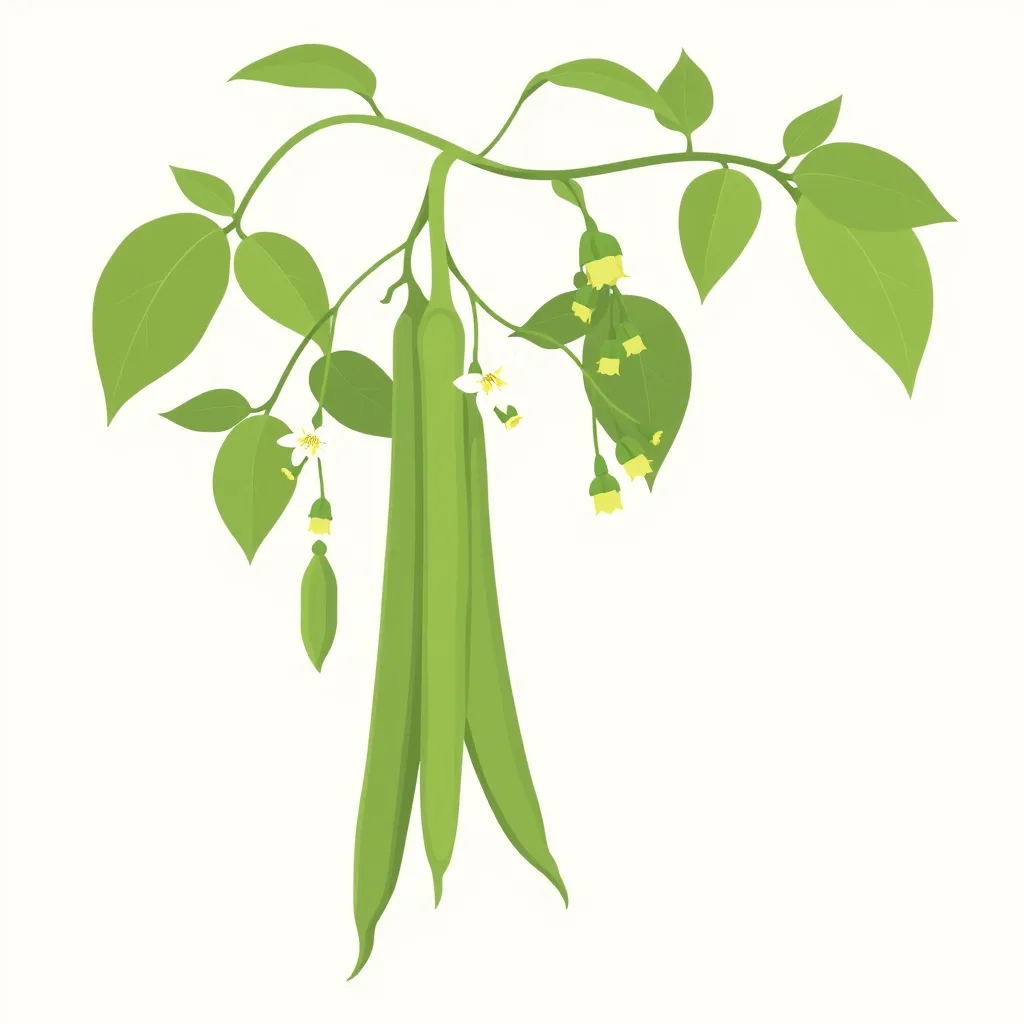
Green bean plants move through five stages between seed and a pod ready to pick: sow, sprout, vine, flower, and pod. Bush varieties reach that last stage in 48 to 60 days and pole varieties in 58 to 70, per University of Georgia Extension, a gap most day-count guides never explain. This spoke sits inside the plant growth stages hub, which tracks the same five-part framework across other vegetable crops.
Every day count in this article is really a temperature count wearing a calendar’s clothes. UGA publishes snap bean’s actual maturity requirement as 1,050 to 1,150 growing degree days at a 50°F baseline, and its own worked example spreads that same requirement across 55 to 86 days depending on when the crop goes into the ground. That is why Clemson Cooperative Extension’s flat 55 days, Utah State University Extension’s 50 to 60 for bush, and UGA’s 48 to 60 bush against 58 to 70 pole are not disagreeing with each other. They are describing the same accumulated-heat requirement measured under different planting conditions.
5 Green Bean Plant Stages: Sow, Sprout, Vine, Flower, Pod
None of the three extension programs checked for this article publishes a numbered or named model for the stages of green bean growth. UGA, Clemson, and Utah State all describe germination, flowering, and days to maturity, but none breaks the plant’s life into labeled phases. The five names above are this site’s own frame for bean plant growing stages, built around the sourced milestones that follow, not a published taxonomy.
Sow is the day seed goes into the ground, at least 1 inch deep once soil reaches 60°F at a 4-inch depth, Clemson’s threshold for planting. Sprout covers germination and first emergence, which UGA times at up to two weeks in 60°F soil and seven days or less at 85°F. Vine is the vegetative stretch between emergence and the first flower, the one span none of the three programs gives a day count for. Flower and pod close out the run, each covered in its own section below, and the full timeline with every sourced day count sits in the calendar table further down this page.
When Should Green Bean Plants Start Flowering?
No program checked here publishes a direct days-to-flowering figure. It can be derived from two published figures: UGA’s 48 to 60 day bush maturity window, minus Utah State’s 7 to 14 days between flowering and a pod ready to pick. That subtraction lands bush plants at roughly 34 to 53 days after sowing before flowering starts, this site’s own arithmetic from two published figures, not a number either program states directly.
Pole varieties run later across the board. Running UGA’s longer 58 to 70 day maturity window through the same subtraction puts pole flowering closer to 44 to 63 days after sowing, a shift of roughly a week and a half at either end of the range compared with bush.
Why Green Bean Plants Sometimes Flower but Never Set Pods
All three programs checked for this article address flowers that never turn into pods, and each sets the heat threshold at a different point. Clemson puts blossom drop risk above 90°F. UGA agrees on 90°F but adds a detail neither of the others publishes: pollen germination suffers “particularly with warm overnight temperatures,” not just a hot afternoon. Utah State sets its threshold higher, at 95°F, describing plants that “shed (abort) flowers” once temperatures cross it.
None of the three is wrong. Two programs are naming a lower, more conservative threshold, and only UGA is naming the mechanism, pollen viability, rather than just the outcome. The night-temperature detail is the most useful of the three: a stand with daytime highs at 88°F or 89°F but warm nights can still lose blossoms, even though every daytime reading stays under each program’s own published threshold.
Green Bean Growth Stage Calendar, Sowing Through Pod Fill
Utah State and UGA between them anchor four of the five stages with a published day count or day range; the fifth, vine, is left honest below because neither program ties it to a number.
5-Stage Green Bean Timeline, UGA, Clemson, and Utah State Extension Sourced Anchors
| Stage | Stage name | Days since sowing | Visible sign | Grower note |
|---|---|---|---|---|
| 1 | Sow | Day 0 | Seed placed in the row | Plant 1 inch deep (Clemson) once soil holds 60°F at a 4-inch depth |
| 2 | Sprout | 7 to 14 days (derived from UGA’s 60 to 85°F germination range); as few as 7 days at 85°F soil, up to two weeks at 60°F (UGA) | Seedlings break the soil surface | Germination speed tracks soil temperature directly; sow into warmer soil for a faster, more even stand |
| 3 | Vine | Not published by any program checked | Leaf and stem growth between emergence and the first flower buds | UGA’s optimal growth range is 60 to 70°F, tolerating 50 to 80°F; this is the stretch that stalls if soil or air stays cool |
| 4 | Flower | Roughly 34 to 53 days, bush (derived); roughly 44 to 63 days, pole (derived) | First blossoms open | Watch overnight temperatures once blossoms open; UGA’s 90°F pollen-viability threshold factors in warm nights, not just daytime highs |
| 5 | Pod | 48 to 60 days, bush; 58 to 70 days, pole (UGA); pods ready 7 to 14 days after flowering (Utah State) | Pods sized and ready to pick | Check pods directly rather than counting from a fixed date; the same maturity window spans 55 to 86 days under UGA’s own degree-day accounting |
Stage 3 carries no day figure from any of the three programs, which is the clearest evidence that “vine” is a temperature-driven stretch rather than a calendar event. Stage 4 and stage 5 both carry a derived range next to a published one; read the derived cells as this site’s arithmetic from UGA and Utah State’s numbers, not as a figure either program states outright.
Converted to weeks, the same table runs sow at week 0, sprout across roughly week 1 to 2, flower somewhere around week 5 to 9 depending on habit, and the first pick-ready pods anywhere from week 7 through week 10. Stretched to UGA’s full degree-day range, the whole calendar can still be running into a third month on a slow-heat planting.
Count Five to Seven Weeks From Sowing to First Bloom
Five to seven weeks after sowing is 35 to 49 days, close to but not identical to the 34 to 53 day range derived above from UGA’s bush maturity window and Utah State’s flowering-to-harvest gap. Both point to the same general stretch, but the derived range is arithmetic from two published figures, not a rule either program states as such.
A bush planting sown once soil holds Clemson’s 60°F minimum, then run through that timeline, should show its first blossoms somewhere inside that five-to-seven week window. A pole planting, using UGA’s longer 58 to 70 day maturity window through the same subtraction, tends to land closer to six to nine weeks, roughly a week and a half later at either end.
How Long From Green Bean Flowering to Pod Fill?
Utah State answers this one directly: pods are “ready for harvest about 7-14 days after flowering.” That is the figure this article uses for the gap between flower and pick-ready pod throughout every derivation above, and it is short enough that a stand checked twice a week rarely misses the window entirely.
What Happens If Green Bean Plants Get Too Much Nitrogen Early
Utah State Extension answers this directly. Its beans guide states that adding more nitrogen “stimulates excessive leaf growth, delay flowering and reduce pod set” (the source’s own wording, kept as published, not corrected here). That delay to flowering is a shift inside the same stage timeline this article tracks throughout, not a separate problem. Utah State names the reason more nitrogen is not simply better, too: “beans fix nitrogen from the air via soil bacteria attached to the plant roots.” The same page adds that “beans have a low fertilizer requirement” to begin with.
UGA’s snap bean bulletin covers fertility too, but as commercial application rates for field production, not as a timing effect on vegetative growth versus flowering and pod set. A rate or ratio is a different kind of information than the timing effect Utah State describes, and this site does not publish product names, brands, or application amounts for any fertilizer or pesticide.
Bush vs Pole Green Beans: How the Stage Timeline Shifts
UGA is the program that publishes a maturity figure for both habits in one place: 48 to 60 days for bush snap beans, 58 to 70 for pole (runner) beans. Clemson’s and Utah State’s figures describe bush beans only, which is why a blanket 50 to 60 day figure quoted for “green beans” in general is really the bush number. Pole varieties run roughly 8 to 10 days later at each end of the range.
Bush vs Pole Timing, UGA Maturity Figures With This Site’s Derived Flowering Columns
| Habit type | Days to flowering | Days to first pick-ready pods |
|---|---|---|
| Bush | 34 to 53 days (derived from UGA and Utah State figures) | 48 to 60 days (UGA) |
| Pole | 44 to 63 days (derived from UGA and Utah State figures) | 58 to 70 days (UGA) |
The right-hand column is UGA’s own figure. The middle column is this site’s subtraction of Utah State’s 7 to 14 day flowering-to-harvest gap from UGA’s maturity window for each habit, not a number UGA publishes for flowering directly.
‘Pod Set’ and ‘Pod Fill’ Explained in Plain Terms
Pod set is the moment a fertilized flower begins forming a pod instead of dropping off the plant. Pod fill is what happens next: the pod lengthening and the seeds inside developing, the stretch Utah State times at 7 to 14 days from flower to a pod ready to pick. A flower that survives the heat thresholds described above has set; the 7 to 14 days after that is fill. Neither term describes anything beyond the day count Utah State already publishes for that gap.
How Many Weeks Does the Whole Green Bean Cycle Take?
The honest answer is that it depends on accumulated heat, not the calendar. UGA’s own worked example for its 1,050 to 1,150 growing-degree-day requirement spreads across 55 to 86 days to maturity depending on when the crop goes into the ground, wider than the flat day counts most guides quote. In weeks, that widest sourced range comes out to roughly 8 to 12.
The narrower day-count figures used throughout this article translate to about 7 to 9 weeks for bush and 8 to 10 weeks for pole. A planting sown into soil closer to Clemson’s 60°F minimum than to UGA’s 60 to 70°F optimum should expect to sit toward the slower end of every range in this article, because the heat sum it needs arrives more slowly, not because anything is wrong with the stand.
Frequently Asked Questions
Do all green bean varieties pass through the same 5 stages? The five stages here are this site’s own organizing frame, not a taxonomy any of the three programs checked for this article publishes, so every variety moves through the same five-part shape in that sense. What differs is pace. UGA Extension puts bush varieties at 48 to 60 days to maturity and pole varieties at 58 to 70, a real gap that widens toward the far ends of each range.
Can cold nights delay green bean plant stages in spring? None of the three programs checked for this article publishes a cold-night delay figure specifically. What they do publish is a floor: Clemson sets 60°F soil at a 4-inch depth as the minimum before planting, and UGA’s optimal growth range is 60 to 70°F. Soil that has not reached that floor is the same condition that stretches UGA’s degree-day requirement toward the slow end of its 55 to 86 day range, so cold spring soil is a plausible drag on the whole timeline, not just one stage.
Why do some green bean plants skip straight to flowering while small? None of the three programs checked for this article publishes a minimum size or leaf count a bean plant must reach before it can flower, unlike a marker such as a leaf count for thinning. So nothing in the sourced record rules out an early bloom on a small plant. The derived flowering window in this article, roughly 34 to 53 days for bush plants, is a mid-range expectation built from published maturity and pod-fill figures, not a floor a plant is required to meet before it can cross it.
Does succession sowing change how stages line up across a bed? Not for any single planting. Each sowing runs its own five-stage timeline from its own sow date regardless of what else is in the bed. What changes is how many timelines run at once. Clemson recommends sowing every 10 to 14 days for a continuous harvest, and Utah State recommends every 14 to 21 days, continuing until mid-July. Both describe staggered stands moving through sow, sprout, vine, flower and pod on their own clocks, they just set the stagger length differently.
Sources
- University of Georgia Extension Bulletin B1369, Commercial Snap Bean Production in Georgia: bush and pole days to maturity, germination temperature range, growing degree day requirement, the 90°F pollen-viability threshold. Written for commercial field production; its crop physiology figures are used here, its Georgia field planting-date calendars are not.
- Clemson Cooperative Extension HGIC, Bush & Pole-Type Snap Beans: days to harvest, minimum soil temperature to plant, planting depth, succession interval, 90°F blossom-drop threshold.
- Utah State University Extension, How to Grow Beans in Your Garden: days to emergence, bush days to maturity, days from flowering to harvest, succession interval, 95°F flower-shed threshold, nitrogen’s effect on vegetative growth, flowering and pod set, and the low fertilizer requirement and root nitrogen fixation of beans.
- The five-stage frame used here follows the same organizing approach worked through for carrot growth stages and poppy seedling stages, and a reader’s own last-frost sowing window is worked through on the planting calendar hub.
Last verified: 2026-08-17, against UGA Extension Bulletin B1369, Clemson HGIC’s bush and pole-type snap bean factsheet, and Utah State Extension’s beans-in-the-garden page.