
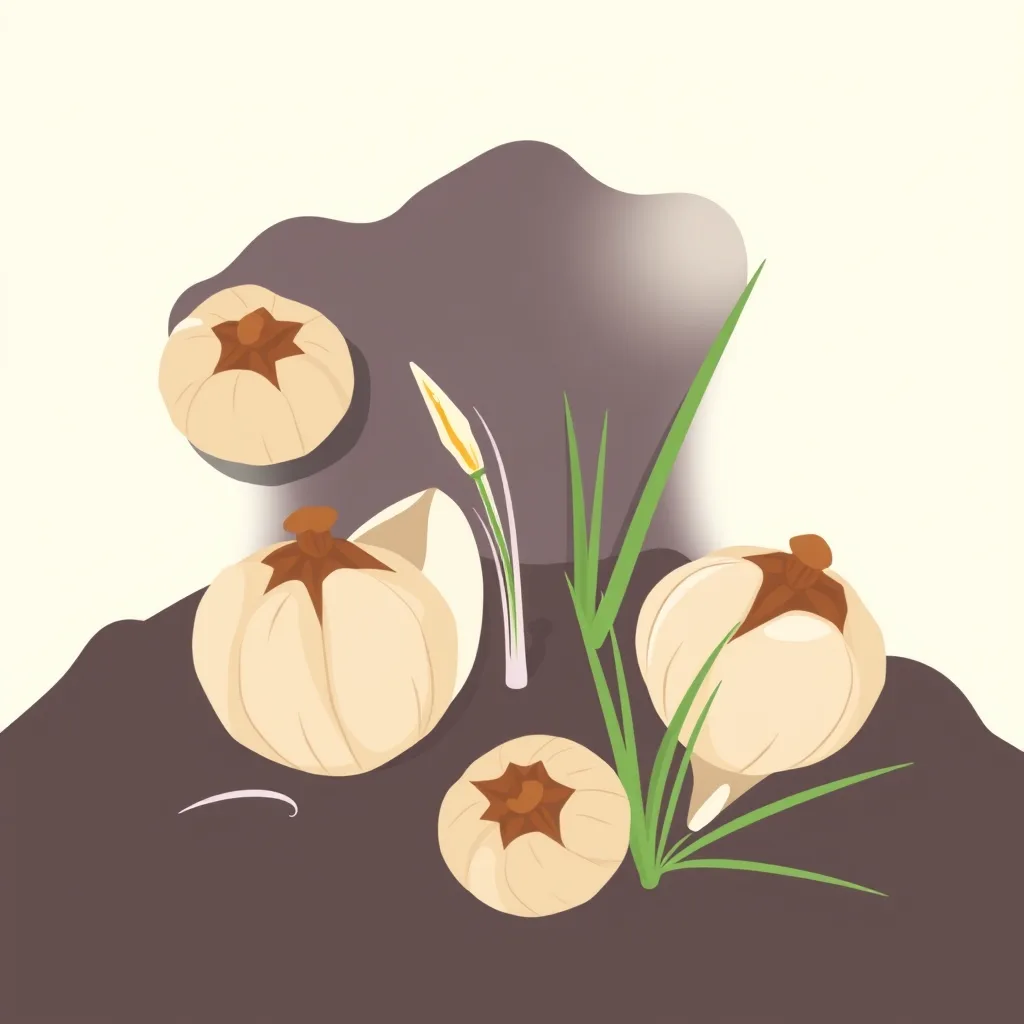
Crocus corms go into the ground once soil at planting depth holds below 60 degrees Fahrenheit, the general fall-bulb trigger Clemson HGIC publishes. UW-Madison Extension’s cold-climate version of the same rule, ground temperature at 50 to 55 degrees F or lower but not yet freezing, names crocus specifically alongside daffodils, tulips, and hyacinth. Depending on region, that trigger arrives sometime between September and November, worked out station by station below. This planting calendar entry covers the corm’s shallower planting depth, the zone-by-zone chilling question, and where a popular count-back rule for crocus actually runs out of published source.
Crocus vs Tulip Bulb Timing: Same Season, Slightly Different Window
Crocus and tulip share the same fall planting season, but crocus corms typically go into noticeably shallower soil, and that depth difference, not a difference in rooting speed, is what shifts crocus slightly earlier within the window.
Clemson HGIC’s spring-bulb depth chart puts crocus at about 3 inches deep, next to 6 to 8 inches for both daffodil and tulip. Soil temperature changes fastest near the surface, so the shallower layer where a crocus corm sits reaches Clemson’s below-60-degree trigger sooner than soil 6 to 8 inches down does. Clemson’s chart states the depths; it never claims crocus roots faster, and neither do Rutgers, UGA, NC State, or UW-Madison. The earlier crossing is this article’s own physical reasoning from the depth gap those sources publish, not a rooting-speed claim any of them make. A gardener can plant crocus first and tulip a week or two later in the same bed without contradicting either source.
Does Crocus Really Need a Hard Freeze to Bloom in Spring?
No. What a crocus corm needs is a sustained cool period, not a hard freeze, and those are different requirements. UGA Cooperative Extension’s Flowering Bulbs for Georgia Gardens (B918) gives the mechanism: in the state’s mildest-winter areas, gardeners precool bulbs artificially, holding them at 40 to 50 degrees F for 12 to 16 weeks, to substitute for a chilling period the ground will not reliably deliver on its own. Forty to fifty degrees sits well above freezing, let alone a sub-32-degree hard freeze.
UGA’s precooling figure is a general spring-bulb rule, not a crocus-specific number; the same page lists crocus among the bulbs that establish on their own where winters run cold enough. Where a corm gets months of naturally cold ground, chill accumulates without any freeze event at all. Where winters stay mild, refrigerated precooling, kept well above freezing, does the same job artificially.
What Old Almanacs Said About Crocus as the First Sign of Spring
Older garden almanacs read a crocus’s first open bloom as one of the earliest visible signals that winter’s worst had passed, a sign noted well before home thermometers or soil probes were common. Gardeners watched for it the way they watched robins or budding trees, a readable marker in a landscape with no measured alternative yet.
Reported here as historical and cultural record only. Nothing in this section claims that a folk sign predicts bloom timing, replaces a measured trigger, or has been tested against one; this site does not verify seasonal sayings and does not treat them as guidance.
What the almanac tradition read as a sign, a modern gardener can read as a number instead: crocus bloom follows the same spring soil-warming trend NOAA’s own climate normals track station by station. NOAA’s normals give no bloom date for any species, so that connection is described here only in direction, not with the figures the rest of this article uses. Readers curious about other seasonal folk markers can find more in this site’s coverage of almanac tradition and phenology.
If You Missed the Fall Crocus Planting Window
A corm planted late still has a place in the ground; it just does not have the same odds. CSU Extension’s guidance on fall-planted bulbs and corms states that bulbs planted too late, after October in Colorado’s framing, “may not have time to root adequately and therefore may not flower uniformly in the spring.” Freeze-thaw cycling over winter can also push an un-rooted corm back up out of the soil.
CSU’s fix is a mulched bed, which holds soil temperature steadier through those swings rather than restoring lost rooting time. A corm with several weeks left before soil locks solid is worth planting regardless of the date on a bag; the soil-temperature logic above matters more than the calendar month. Once ground is frozen solid, digging in is no longer realistic, and that corm is better held over for the following fall. CSU’s own wording, “not flower uniformly,” sets the honest expectation: reduced or uneven bloom the first spring, short of total failure.
Crocus Bulb Timing by USDA Zone, Zone 3 Through Zone 11
A USDA hardiness zone number answers one of these three questions correctly and cannot answer the other two, and that split is worth stating before the table below. A zone number is built from average winter minimum temperature, exactly what a chilling requirement responds to, so the pre-chilling column below is genuinely zone-keyed. Planting window and bloom month are not: both follow local soil cooldown and local spring warm-up, and two towns inside the same zone can differ by weeks on either measure. So rather than manufacturing exact dates and months per zone, the table groups zones into three coarse bands and points the other two columns toward the trend a zone actually predicts, sending the reader to their own NOAA station for the exact local date.
Crocus Bulb Timing by USDA Zone Band
| USDA Zone Band | Soil-Trigger Timing Trend | Pre-Chilling Needed | Bloom Timing Trend |
|---|---|---|---|
| Zones 3 to 6 (cold winter) | Crosses earliest, often September into October | No | Earliest-blooming band of the three, once spring soil warms |
| Zones 7 to 8 (transitional) | Typically crosses October into November | No | Blooms later than zones 3 to 6, earlier than zones 9 to 11 |
| Zones 9 to 11 (mild winter) | May arrive late, or not reliably in-ground | Yes, per this site’s application of UGA’s rule below | Georgia-scoped: 2+ weeks earlier than zone 7 in-state; not a national rule |
Only the pre-chilling column above tracks the zone number as actually defined; the Yes/No split at zones 8 and 9 is this article’s own reasoned application of UGA’s chilling rule above, not a per-zone chart any source publishes. The other two columns describe a direction, not a date: a zone 6 garden and a zone 7 garden can sit a few hundred feet of elevation apart in real life.
When to Plant, Set, or Tuck In Crocus Bulbs
Plant, set, or tuck in, whichever verb a gardener uses, names the same task: placing the corm (crocus grows from a corm, a solid swollen stem base, not a layered true bulb like tulip or daffodil) into fall soil once it has cooled to the trigger temperature above.
How deep is where the sources genuinely disagree, worth reporting as a spread rather than one picked figure. UGA CAES B918 lists crocus at 2 inches deep, 2 to 3 inches apart. NC State’s Plant Toolbox gives “about 2.5 inches deep and 2 inches apart, 35 to 70 corms per square foot.” Clemson HGIC gives 3 inches deep, 3 to 4 inches apart. Rutgers NJAES FS1220 gives “three to four inches deep and three to four inches apart.” That is a real 2-to-4-inch spread across four Tier-1 programs, not a rounding difference.
CSU Extension separately gives depth as four times the corm’s own height. Clemson HGIC’s chart is the outlier on measurement axis, not CSU’s: Clemson calls for three to four times the bulb’s width, measured from the base of the bulb, while Rutgers NJAES FS1220 sets depth at two to three times the bulb’s height. Rutgers and CSU agree on measuring by height and still land on different multipliers, two to three times height against four times height. Planting straight from a bag without a ruler, the safe target sits anywhere inside the 2-to-4-inch range.
When Should You Plant Crocus Bulbs in Zone 6?
Zone 6 sits in the cold-winter band above, zones 3 to 6, where the soil trigger is reached earliest in the fall season and natural winter chill is more than sufficient, so pre-chilling is not needed. Soil at crocus planting depth, 2 to 4 inches per the range above, most often crosses Clemson’s below-60-degree threshold sometime across the September-to-October cooldown in a zone 6 climate; a reader’s own nearest NOAA station is the way to check actual local timing rather than relying on the zone number alone.
None of the five sources give an exact bloom month for zone 6, but UGA’s Georgia data shows warmer zones bloom earlier than cooler ones; extending that trend, zone 6 crocus should bloom later than a milder zone, without a specific month attached.
Why Crocus Bulbs Sometimes Fail to Come Up in Spring
Three separate causes explain most no-shows, pointing to different stages of the process.
Planted too shallow for local conditions is one. The 2-to-4-inch spread above is real, and a corm set at the shallow end in a colder zone has less soil buffering it from winter’s coldest swings than one planted deeper in the same range.
Rodent disturbance is a second cause, and it is timing-related rather than a depth mistake. Clemson HGIC and Rutgers NJAES both note that animals dig up freshly planted crocus corms over winter. CSU Extension adds the mechanism, citing squirrel-behavior research from UC Berkeley: freshly disturbed soil is a visual cue that draws foraging animals to the exact spot, so corms are most vulnerable in the weeks right after planting, not once a bed is established. A corm simply missing in spring was never a chilling or depth failure at all.
Insufficient chilling in a warm zone is the third, tying back to the zone table above. In zones 9 to 11, ground temperatures may never hold UGA’s 40-to-50-degree precooling range for the full 12 to 16 weeks, so a corm planted without artificial precooling can survive winter but fail to flower well.
Crocus Bulb Planting Calendar, September Through November
Fall frost timing shifts the whole planting season earlier or later by region, even though the underlying soil trigger stays the same everywhere. NOAA/NCEI’s 1991-2020 Climate Normals give a first fall frost (32 degrees F) for one station per region, useful as a seasonal marker even though it is an air reading, not the soil-depth trigger itself:
Crocus Fall Planting Calendar, Regional Stations
| Station (Region) | First Fall Frost, 32°F | Where the Soil-Trigger Window Generally Falls |
|---|---|---|
| Minneapolis-St Paul, MN (cold) | Oct 18 | Soil often crosses below 60°F in September, ahead of this frost date |
| St Louis, MO (transitional) | Nov 4 | Typically crosses in October |
| Atlanta, GA (mild) | Nov 20 | Crosses later, often into November |
| New Orleans, LA (very mild) | Dec 31 | Ground rarely cools enough on its own; precooling substitutes, per the table above |
These are air temperatures, and soil at planting depth lags behind them, staying warmer longer in fall. A station’s frost date is not the planting date itself, only the point by which the season’s cooldown is unmistakably underway.
Count Back Two to Three Weeks From Your Ground Freeze Date
No NOAA/NCEI dataset publishes a ground-freeze date for any US station, checked directly against the 1991-2020 Climate Normals’ published fields. What NOAA/NCEI does publish is air-temperature thresholds, a first fall frost at 32 degrees F and a colder hard-freeze figure at 28 degrees F, both earlier and different events than the ground actually freezing solid.
So a literal two-to-three-week count-back from a ground-freeze date has no station figure behind it for crocus, the same gap this site has found checking the same rule for tulip and garlic. The 32-degree first-frost date is a usable early warning that the season’s soil cooldown is well underway, clearly an air reading rather than a soil one. The soil-temperature trigger covered above, below 60 degrees F at planting depth, or 50 to 55 degrees F in the cold-climate framing, is the number a reader can actually check on the ground rather than count back to.
Frequently Asked Questions
Do crocus bulbs multiply on their own after the first year? NC State’s Extension Gardener Plant Toolbox describes crocus propagation as division, recommended about every four years, the sourced sign that an established planting spreads and thickens over that span rather than needing yearly replanting. NC State’s page gives no first-year multiplication count.
Can crocus bulbs be planted in the same hole as tulip bulbs? Clemson, Rutgers, UGA, NC State, and CSU do not address planting two bulb species in one hole, sometimes called layering, for garden beds. A UC Master Gardener Program blog post, credited to Lauren L Snowden and Melissa G Womack, does describe combining crocus and tulip at different depths, but as a container technique for potting soil in a 12 to 14 inch pot, not a garden-bed one. What is sourced for garden beds is the depth gap: crocus’s 2 to 4 inch range above sits well above tulip’s 6 to 8 inch depth per Clemson HGIC’s chart, the mechanical basis some gardeners use for that idea, without this article endorsing the practice.
Why do some crocus blooms open only on sunny days? NC State’s Plant Toolbox states that crocus flowers bloom in early spring, “typically closing at night or on cloudy days and opening up with the morning sun.” That response to light and warmth, not a fault in the corm, is why a clump can look closed one overcast afternoon and wide open the next sunny one.
Does mulching change crocus planting depth recommendations? No. CSU Extension’s fall-bulb guidance recommends mulching a bed to hold soil temperature steadier through winter’s freeze-thaw cycling, a covering added on top of the planting depth, not a change to it. None of the depth figures compared here, 2 to 4 inches across four programs, adjust for whether a bed is mulched.
Sources
- Clemson HGIC, Spring-Flowering Bulbs: soil trigger, depths, disturbance fact.
- Rutgers NJAES FS1220: corm definition, depth, disturbance fact.
- UGA CAES B918: precooling rule, depth, zone 9 vs 7 bloom note.
- NC State Plant Toolbox, Crocus: depth, bloom-light behavior, division note.
- CSU Extension, Fall-Planted Bulbs and Corms: late-planting risk, mulching, depth rule.
- CSU Extension, Squirrel-Proof Your Bulbs: disturbed-soil mechanism only.
- UW-Madison Extension: the 50 to 55 degree F trigger naming crocus.
- UC Master Gardener Program Statewide Blog, Snowden and Womack: container bulb-layering technique, Tier 2, cited in the FAQ only.
- NOAA/NCEI 1991-2020 Climate Normals: Minneapolis-St Paul, St Louis, Atlanta, New Orleans.
- USDA Plant Hardiness Zone Map, 2023.
This site’s fall-bulb coverage continues with Pennsylvania’s tulip bulb timing and North Carolina’s tulip bulb timing.
Last verified: 2026-08-20, against Clemson HGIC, Rutgers NJAES FS1220, UGA CAES B918, NC State’s Plant Toolbox, CSU Extension, UW-Madison Extension, NOAA/NCEI Climate Normals, and the USDA 2023 Zone Map.