
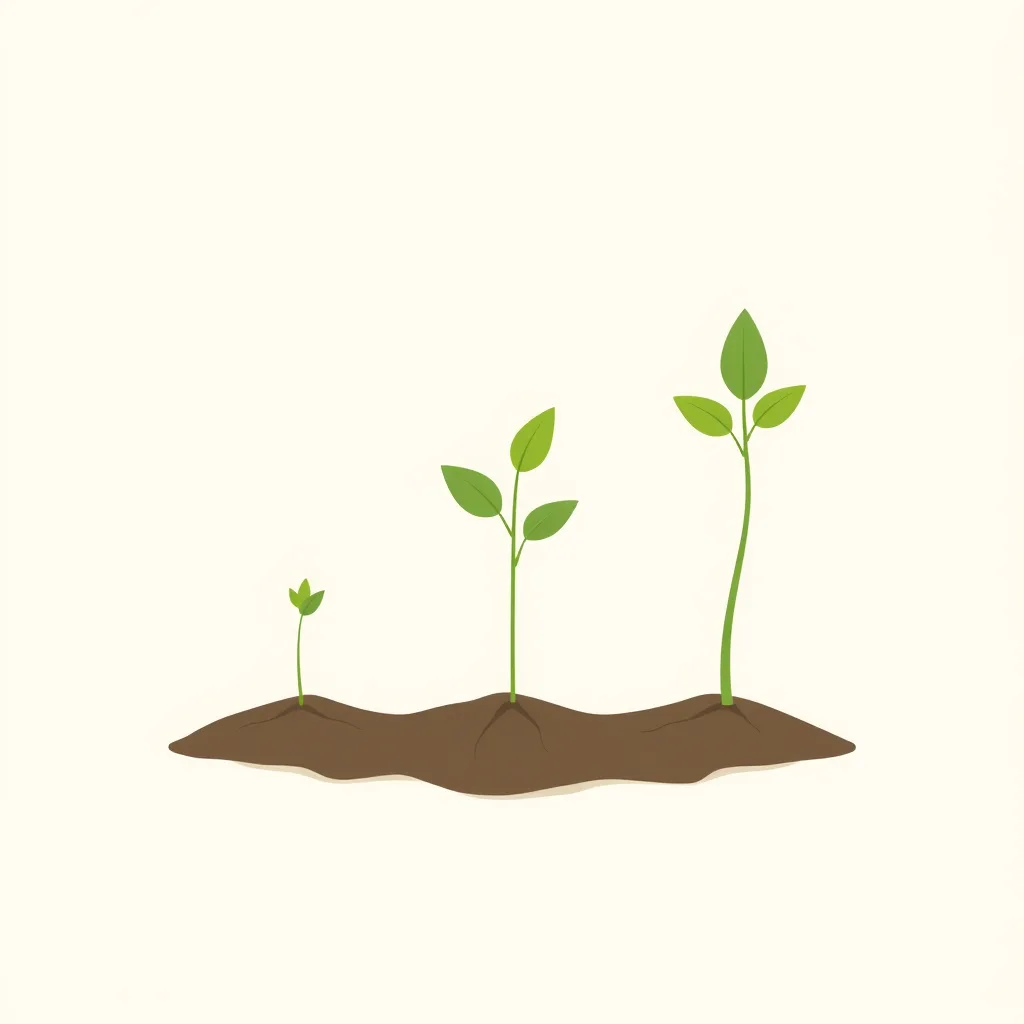
A tomato plant needs roughly 52 to 90 days after transplant to reach first harvest, while a field corn hybrid needs 120 to 150 days after planting to reach physiological maturity. Both paths are commonly described using the same six-stage framework: germination, seedling, vegetative growth, flowering, fruit set, and maturity. Whether that framework actually fits every plant is a separate question, covered below.
What ‘Growth Stage’ Actually Means Versus ‘Growth Phase’
A growth stage is a specific, identifiable checkpoint in a plant’s development, such as “first true leaf” or “tasseling,” usually tied to something you can see. A growth phase is the broader window that groups several stages together, such as “the vegetative phase,” which can span weeks and many individual stages inside it.
Corn’s staging system, published by Iowa State Extension, makes the distinction concrete. The vegetative phase alone is broken into V1 through V(n), one stage per leaf collar, with 18 to 21 leaves typical before the plant reaches VT (tasseling). So “vegetative phase” is one word for a stretch of time, while “V6” is one specific stage inside it. Reproductive stages follow the same pattern: R1 (silk) through R6 (physiological maturity) are individual stages within the broader reproductive phase. Most home-garden guides collapse this detail into a single word, “vegetative” or “flowering,” which is accurate as a phase label but hides how many discrete stages actually sit inside it.
How Many Growth Stages Does a Typical Vegetable Crop Have
The answer depends entirely on which staging system is counting. A general vegetable framework names five to six broad stages: germination, seedling, vegetative growth, flowering, fruit set, and maturity. A crop-specific system built for field monitoring can name far more. Iowa State Extension’s corn system alone lists roughly 20 individual vegetative stages (V1 through V18 to V21, typical) before reproductive staging even begins, on top of six reproductive stages, R1 through R6.
So a vegetable growth stage count of “six” and a corn stage count that runs past 20 are not disagreeing; they are measuring at different resolutions. A home gardener tracking tomato or pumpkin by eye is using the coarse six-stage version. A commercial corn grower staging a field for a fungicide-timing or nitrogen decision needs the finer leaf-collar count. Both are legitimate; neither is “the” real number.
Germination Stage vs Vegetative Stage: What Actually Changes
Germination is the period when a seed absorbs water, its radicle (first root) emerges, and it draws on stored seed reserves rather than its own photosynthesis. Vegetative growth begins once the seedling’s true leaves unfurl and the plant becomes self-sufficient, building roots, stems, and leaf area from sunlight rather than from what was packed into the seed.
Lawn grasses make the same split easy to watch, because their germination stage is measured in days rather than weeks: see how quickly rye grass sprouts, the slower pace of Kentucky bluegrass, and where tall fescue falls between them.
Corn’s germination is soil-temperature gated: Purdue Extension (NCH-40) puts germination near 50°F soil. Once past emergence (VE) and into the leaf-collar sequence, the plant has entered its vegetative phase and its pace now tracks accumulated heat rather than a single temperature threshold. Tomato shows the same shift in practice, even though Clemson HGIC’s tomato guidance frames it operationally rather than biologically: seed is started indoors six to eight weeks before the last frost, and by the time a seedling is 6 to 10 inches tall, it has moved well past germination into active vegetative growth and is ready to transplant.
Does Every Plant Really Pass Through the Same Six Stages
No. The six-stage framework (germination, seedling, vegetative, flowering, fruit set, maturity) is a teaching convention built around annual vegetable crops, and it breaks down for two large groups.
Grasses use their own vocabulary. Turfgrass and lawn species add a stage the six-stage vegetable framework has no word for: tillering, when a grass produces new shoots from its base rather than simply growing taller, followed by vegetative and reproductive stages that look different from a tomato’s. A separate set of germination-time articles on this site covers cool-season lawn species in that vocabulary specifically.
Woody perennials do not reset to seed every year, so “maturity” is not an annual endpoint for them the way it is for a tomato plant. A shrub like hydrangea instead carries a standing structure forward across seasons, setting flower buds on old or new wood depending on type and moving through dormancy and leaf-out annually without restarting from germination.
And within the six-stage frame itself, corn’s own system already disagrees with the count: it splits “vegetative” into roughly 20 individual stages and “reproductive” into six more. Calling that “six stages” is a simplification, not a wrong one, but a simplification the reader should know they are getting.
What Old Almanacs Watched For Between Sprout and Flowering
Older agricultural traditions leaned on indicator-plant sayings rather than a thermometer to time field work between sprouting and flowering. One of the most widely repeated is the guidance to plant corn once oak leaves reach roughly the size of a squirrel’s ear, a folk marker meant to signal that soil had warmed enough for reliable germination.
This is tradition and cultural history, not a forecast and not advice. These sayings were a practical workaround before soil thermometers and extension bulletins were common, tying a farming decision to something observable in the same local environment rather than a fixed calendar date. Reporting that a saying exists and was used is not the same as claiming it predicts anything, and nothing about the modern growing-degree-day method covered later on this page confirms, validates, or explains why any particular folk sign works. The two belong to different traditions of observation, and this page keeps them separate.
If Your Plant Seems Stuck at One Stage, Start Here
A plant that appears frozen at the same stage for weeks is usually responding to one of a small set of measurable conditions, not failing randomly. Work through these in order:
- Soil temperature below the crop’s threshold. Corn will not reliably germinate below roughly 50°F soil (Purdue NCH-40); pumpkin needs soil near 65°F to be planted at all (Utah State Extension). A seed or seedling sitting below its threshold is not stalled, it simply has not started the clock yet.
- Insufficient accumulated heat since planting. Growth stages track heat units over time, not days on a calendar; a cool stretch of weather can slow a plant’s progress toward its next stage even with no other problem present (see the growing-degree-day method below).
- Transplant stress. A seedling moved outdoors before it has hardened off, or moved during a cold snap, often pauses visible growth while it reestablishes roots.
- Day length. Some crops will not move into their next developmental stage until day length crosses a threshold, regardless of temperature or plant size.
- Crowding or shading. Seedlings planted too close together compete for light and can appear stuck in a vegetative holding pattern until thinned, which is part of why Utah State Extension specifies thinning pumpkin to two plants per mound once seedlings reach two leaves.
Growth Stage Timelines by Crop: Tomato, Pumpkin, and Corn Compared
No single university extension page publishes tomato, pumpkin, and field corn timelines side by side; the table below combines three separate crop-specific sources into one comparison. The pumpkin row is summarised here; the full stage-by-stage pumpkin timeline covers it in more detail, and the five potato stages work through a crop whose published stage ranges overlap rather than run in sequence. Duration figures are stage-specific where the source provides them, and marked as not sourced where it does not, rather than estimated.
Growth Stage Timelines: Tomato, Pumpkin, and Corn Compared
| Plant | Stage | Typical Duration | Visual Sign | Related Soil/Weather Condition |
|---|---|---|---|---|
| Tomato | Sowing to transplant-ready seedling | About 6-8 weeks (indoor) | Seedling 6-10 inches tall | Growing temperature 70-80°F day, 60-70°F night (Clemson HGIC) |
| Tomato | Transplant to first harvest | 52-90 days, cultivar-dependent | Fruit reaches mature size and color | Soil at transplant 60 to 65°F (UGA CAES) |
| Pumpkin | Sowing/planting | Not individually sourced | Soil at 65°F, or after frost danger passes | Earliest planting 2 weeks before last frost, only with plastic mulch and row covers (Utah State Extension) |
| Pumpkin | Seedling to thinning | Not individually sourced | Two true leaves present | Thin to two plants per mound at this point |
| Pumpkin | Flowering to mature fruit | 45-55 days | Not individually sourced | Row covers removed at flowering or above 90°F |
| Field/grain corn | VE emergence | Not individually sourced | Coleoptile breaks soil surface | Germinates near 50°F soil (Purdue NCH-40) |
| Field/grain corn | V1 through V(n) leaf-collar stages | Spans most of the 120-150 day season; no single-stage duration published | 18-21 leaf collars typical before tasseling | Optimal day 77-91°F, night 62-74°F |
| Field/grain corn | VT tassel through R6 physiological maturity | Full sequence completes within 120-150 days from planting (full-season hybrid) | Silk (R1) through kernel fill (R2-R5) to black layer (R6) | Iowa State Extension Corn Growth Stages; Purdue NCH-40 |
The corn row is labeled “field/grain corn” deliberately. The 120 to 150 day figure runs to R6, the point Iowa State Extension defines as physiological maturity, not the point of harvest. It is not a sweet-corn eating-stage figure; sweet corn is picked earlier, before grain maturity, and no sweet-corn days-to-harvest number appears in the sourcing behind this table. Extension pages for field corn and sweet corn rarely say this plainly in the same breath, and treating the two as one number is a common source of confusion this comparison is built to avoid.
The 60 to 65°F tomato transplant-soil figure comes from a single UGA CAES page, not a cross-checked multi-source range, so treat it as one extension program’s guidance rather than an industry consensus.
Seedling, Sprout, or Seed: Sorting Out the Early-Stage Vocabulary
These three words describe three different points, even though gardeners often use them loosely as synonyms. A seed is the dormant starting unit, containing an embryo and stored food reserves, not yet growing. To sprout or germinate describes the active process of a seed taking up water and pushing out its first root, the transition out of dormancy. A seedling is the young plant that results once true leaves have formed and it can support its own growth through photosynthesis rather than seed reserves.
“Sprout” gets used two ways in casual speech, as a verb (the seed sprouted) and informally as a noun for a very young plant, which is where most of the confusion comes from. Extension terminology keeps the verb sense and reserves “seedling” for the young-plant noun, a distinction worth keeping straight when reading a crop-specific staging guide.
When Should You Expect the First True Leaves to Appear
True leaves unfurl after the initial pair of cotyledons (seed leaves), and how soon that happens varies by crop rather than following one fixed window across species. Cotyledons are not true leaves; they are the embryonic leaf structures already packed inside the seed, and their job is to power initial growth, not to identify the plant’s actual leaf shape.
Pumpkin gives a sourced example of a stage marker tied to true leaves rather than a fixed day count: Utah State Extension times thinning to “after they have two leaves,” using leaf presence, not a calendar date, as the trigger to thin seedlings to two plants per mound. That is a useful pattern more broadly: watching for the true-leaf stage itself is generally more reliable than counting days since sowing, since soil temperature and light conditions shift how quickly any given seedling gets there.
Why Some Seedlings Never Reach the Flowering Stage
Some seedlings grow steadily through the vegetative stage and simply never make the transition to flowering, and the causes are almost always measurable rather than mysterious.
Insufficient accumulated heat is the most common cause. A plant that needs a certain heat-unit total to trigger flowering will stay vegetative indefinitely in a cool season that never delivers it, which is part of why the growing-degree-day tracking method below exists as an alternative to counting calendar days.
Day-length sensitivity stalls some crops outright. Certain species will not shift into their reproductive stage until day length crosses a threshold, regardless of how large or healthy the plant otherwise looks, which can leave a vegetatively vigorous plant flowerless through an entire short-day or long-day stretch.
Transplant stress and crowding both delay the transition. A seedling that never fully recovers from a rough transplant, or one competing heavily with neighbors for light, often channels its limited energy into surviving rather than advancing to the next stage.
A shortened season can end before flowering is reached at all. Field corn’s own staging system illustrates this directly: a plant that has not accumulated enough heat to reach VT (tasseling) by the time cool fall weather arrives simply runs out of season before its reproductive stages (R1 through R6) can begin.
None of these causes involve a product, a treatment, or an input; they are conditions to identify, not problems to spray.
Plant Growth Stages Week by Week From Germination to Harvest
This weekly timeline uses summer squash as one illustrative crop, sourced to Clemson HGIC, because it is direct-sown and reaches first harvest in about 8 weeks, with continued fruit production through about week 12. Tomato, by contrast, needs 6 to 8 weeks of indoor growth before transplant even begins, so no single weekly table applies to every plant on this page; treat this as one worked example, not a universal calendar, consistent with the myth correction above.
Summer Squash Growth Stages, Week by Week
| Week | Soil/Growing Condition | Visual Sign | Decision Point |
|---|---|---|---|
| Week 0 | Soil temperature confirmed at 60°F, measured 4 inches below the surface | Seed ready to sow | Direct-sow into warm soil |
| Weeks 1-2 | Soil warm and consistently moist | Germination and emergence (specific day count not individually sourced by Clemson) | Watch for seedling emergence before assuming a poor stand |
| Weeks 3-5 | Continued warm-season conditions | Vegetative growth, vining begins (stage-specific duration not individually sourced) | Monitor spacing and sun exposure |
| Weeks 6-8 | Approaching the sourced 55-day span to first harvest | Fruit sized for harvest: crookneck/straightneck 1.5-2 inches, zucchini 7-8 inches, scallop 3-4 inches | Begin checking plants for harvest-ready fruit |
| Weeks 8-12 | Ongoing warm-season growth | Continued fruit set | Harvest daily or every other day to keep the plant producing |
Clemson’s summer squash factsheet gives the 60°F sowing threshold and the roughly 55-day span to first harvest directly, but it does not break germination or vegetative growth into individually timed sub-stages, and this table does not invent numbers to fill that gap. The harvest sizes above are garden-readiness signs for picking, not a claim about how the crop stores afterward.
Count Growing Degree Days, Not Calendar Days, to Track Stages
Growing degree days (GDD) are a running total of heat accumulated since planting, and they track a plant’s actual developmental pace far better than counting calendar days does, since two identical planting dates in different microclimates will accumulate heat at different rates. The standard method: take the day’s average temperature (high plus low, divided by two), subtract the crop’s base temperature, and add the result to a running seasonal total. Any day where that subtraction would go negative is floored to zero rather than subtracted from the total.
Purdue Extension (NCH-40) publishes two base temperatures relevant here: 50°F for warm-season crops, including corn, and 40°F for cool-season crops such as wheat, oats, and peas. Below its base temperature, a crop accumulates no growth for that day even if the air is well above freezing, because development simply has not started for that species at that temperature.
No sourced accumulated-GDD figure exists for reaching a specific stage, such as “corn tasseling at X GDD,” in the sources behind this page, and none is stated here. The method above is sourced and reliable; a specific stage-trigger number would not be. Readers who want to track a specific crop’s GDD accumulation locally can typically find a running seasonal total through their state’s extension GDD tool or a NOAA weather-station-based calculator.
How Long Does Each Growth Stage Typically Last
Stage duration varies by crop, by which stage is being measured, and by the weather that season, so there is no single number that applies across plants. What the sources behind this page do support:
- Tomato, transplant to first harvest: 52 to 90 days, cultivar-dependent (Clemson HGIC).
- Pumpkin, flowering to mature fruit: 45 to 55 days (Utah State Extension).
- Summer squash, sowing to first harvest: about 55 days (Clemson HGIC).
- Field/grain corn, planting to R6 physiological maturity (staging per Iowa State Extension): 120 to 150 days, depending on hybrid maturity rating (Purdue NCH-40).
Notice these figures measure different spans of the same plant’s life. Tomato and squash are both counted from a planting action to harvest readiness, which folds several individual stages into one number. Pumpkin’s figure starts at flowering, a single later stage, not at sowing. Corn’s figure runs the entire sequence, VE through R6. Comparing these numbers directly without noting what each one actually measures is the single easiest mistake to make when reading crop timelines side by side, and it is the same lesson the myth-correction section above makes about stage counts generally: always check what is actually being measured before comparing two numbers.
Frequently Asked Questions
Is a growth stage the same thing as a life cycle stage? Not quite. A growth stage marks a specific developmental checkpoint inside a plant’s growth, such as first true leaf or tasseling. A life cycle stage is the broader category, such as annual versus perennial, that determines whether the plant resets to seed every year or carries its framework forward across seasons.
Why do two plants of the same variety reach stages at different times? Heat accumulation, not the calendar, drives stage timing. Two tomato transplants set out the same week can reach flowering days apart if one sits in a warmer microclimate, because development tracks growing degree days rather than the number of days since planting.
Can cold weather reverse a growth stage? A plant does not step backward to an earlier stage, but cold can pause development for days or weeks by slowing the heat accumulation that stage transitions depend on, and a hard freeze can kill tissue outright rather than reverse its stage.
Do indoor and outdoor plants follow the same stage timeline? The stage sequence is the same, but the pace differs. Indoor seedlings under stable temperatures often reach early stages faster than the same variety sown directly outdoors into cooler, more variable spring soil, which is part of why extension programs give indoor sowing a head start of six to eight weeks for crops like tomato.
What is the fastest way to estimate what stage a plant is in? Compare what you see (leaf count, presence of flowers, fruit set) against a crop-specific staging guide from a university extension program rather than counting calendar days, since visual stage markers are far more reliable than days-since-planting for estimating where a plant actually is.
Sources
- Clemson HGIC, Tomato for indoor sowing lead time, transplant conditions, and days to first harvest.
- UGA CAES for the 60 to 65°F tomato transplant soil-temperature threshold (2013, single-source).
- Clemson HGIC, Summer Squash for sowing soil temperature, days to harvest, and harvest-size markers.
- Utah State Extension, Pumpkins in the Garden for planting conditions, thinning timing, and flowering-to-maturity duration.
- Iowa State Extension, Corn Growth Stages for the V-stage and R-stage system.
- Purdue Extension NCH-40, Growing Season Characteristics and Requirements in the Corn Belt for germination temperature, full-season maturity range, and growing-degree-day base temperatures.
Last verified: 2026-08-15, against the Clemson HGIC, UGA CAES, Utah State Extension, Iowa State Extension, and Purdue Extension pages cited above.