
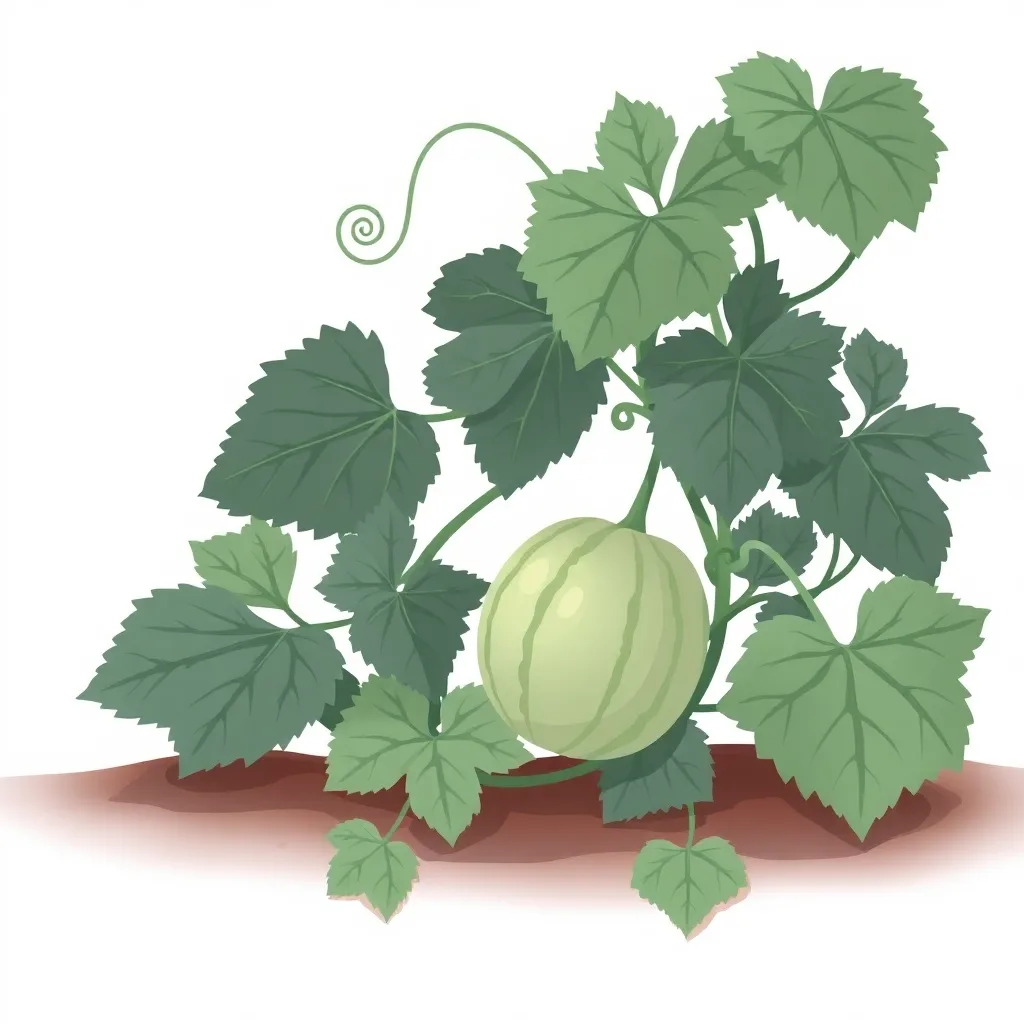
A single browned tendril does not confirm that a watermelon has finished its fruit-sizing stage. Watermelon growth stages run from germination to full-size fruit in about 85 to 90 days from transplant, per Clemson Cooperative Extension, or a wider 80 to 100 days per University of Maryland Extension, a range UF/IFAS Gardening Solutions gives as well and ties to variety. Clemson separately notes that starting from transplants can finish full-size fruit as much as two weeks earlier than starting from direct-seeded plants. The six-stage table below tracks each stage by vine sign, not by tendril color alone. This spoke sits inside the plant growth stages hub, which tracks the same stage-by-stage approach across other garden crops.
The page below tracks that arc week by week, using Clemson, UMD, and UF/IFAS Gardening Solutions data. It opens with how watermelon’s fruit-development window actually compares to cantaloupe’s, since the two crops get lumped together more often than the sourced record supports.
Watermelon vs Cantaloupe Growth Stages: Where the Timelines Diverge
The gap between watermelon and cantaloupe is smaller than the assumption that cantaloupe finishes faster. Clemson HGIC’s watermelon factsheet gives about 35 days from fruit set to full-size fruit. Its separate cantaloupe and honeydew melons factsheet gives 30 to 35 days from pollination to harvest for cantaloupe. Those two fruit-development windows sit almost on top of each other.
University of Maryland Extension does not split the two crops apart on the whole-cycle figure either. Its Melons page gives one shared range, 80 to 100 days from transplanting, that covers both muskmelon and watermelon rather than assigning cantaloupe a shorter number. UMD does separate them botanically: “Melons grown in Maryland, except watermelon, are in the species Cucumis melo,” while watermelon is Citrullus lanatus, a different genus entirely.
So the gap is not because one crop’s biology moves categorically faster. It is closer to watermelon’s vines needing more room to run: Clemson’s own watermelon-specific total, 85 to 90 days, sits at the faster end of UMD’s broader 80 to 100 day melon range, not clearly behind cantaloupe. No cantaloupe-specific total published here beats watermelon’s.
Does a Dry Tendril Really Mark the End of the Fruit-Sizing Stage?
Not by itself. Clemson HGIC lists four cues together for a watermelon that has reached full size: expected size for the variety, tendril browning, a loss of skin gloss, and a ground-spot color change from white to cream. University of Maryland Extension pairs a yellowish ground color with a dead or curled tendril as its own two-signal combination. UF/IFAS Gardening Solutions independently pairs ground-spot color with tendril browning and shriveling as well.
Three extension programs land on the same structure: a tendril is one of several signs, not a stand-alone test. Treat it as a prompt to check the fruit’s ground spot and general size too, not as confirmation on its own that the fruit-sizing stage is complete.
What Old Growers Watched For at the End of the Fruit-Sizing Stage
Reported here as a documented habit, not as a validated stage check this site endorses: thumping a watermelon and listening for a dull, hollow sound is a widespread grower practice that predates any published day count and is still recorded today, in University of Maryland Extension’s own melon guide. No source checked for this article measures that sound against Clemson HGIC’s roughly 35-day fruit-set-to-full-size window, and nothing here claims the two line up.
The habit survived into a current extension publication without ever being tested against a measured day count. It sits alongside, not in place of, the ground-spot and tendril cues covered above.
If Your Watermelon Vines Are Behind Schedule by Midsummer
By midsummer, the choice between seed and transplant is already made, so the lever that shortens the total, starting from transplants instead of seed, is not available anymore. What still matters is Clemson’s fixed 35-day fruit-set-to-full-size window, counted forward from whenever fruit set actually happens on that particular vine, not from a fixed calendar date.
Watch for the vine signs instead: flowering along the vine, then a swelling ovary sitting just behind a female flower, UMD’s description of fruit set beginning. The whole-cycle range already spans 5 days by Clemson’s count (85 to 90) and 20 days by UF/IFAS’s and UMD’s wider figure (80 to 100), so a vine that looks behind schedule against one source’s number may still be inside another’s. Readers tracking a root crop on a different clock can compare how carrot growth stages progress week by week. The next section counts the remaining runway against your own first-fall-frost date.
Watermelon Growth Stage Timing by USDA Zone and Planting Date
A USDA zone number sorts winter cold, not the length of frost-free season a fixed-duration crop like watermelon needs to finish. Two towns sharing one zone can still see their first fall frost land six or more weeks apart, so the zone number alone cannot set a planting date here.
What can is counting backward from your own station’s first-fall-frost normal. Clemson’s transplant total runs 85 to 90 days; UMD gives a wider 80 to 100 days from transplanting, and UF/IFAS gives the same range, attributing the spread to variety. Add a margin for a slower season, a buffer choice this article suggests rather than a sourced figure, say 7 to 10 days: 85 plus 7 is 92 days needed before frost at the fast end of Clemson’s range, and 100 plus 10 is 110 days at the slow end of UF/IFAS and UMD’s wider range. Find your own first-fall-frost normal on the planting calendar hub, sourced to NOAA and NWS station data, and count back from there.
The spring side sets the other boundary. Neither method can start until the local last-spring-frost risk has passed and the soil has reached Clemson’s 60 to 65°F threshold at a 4-inch depth, and that same NOAA-normal lookup answers both ends of the season.
6 Watermelon Growth Stages From Seed, Sprout, to Fruit Set
Clemson, University of Maryland, and UF/IFAS each publish pieces of a watermelon’s timeline; none numbers or labels them as stages. The six rows below sort those sourced pieces into a sequence; the ordering is this page’s structure, not a stage system carried by any single program checked here.
6-Stage Watermelon Growth Timeline, Clemson, UMD and UF/IFAS Sourced Anchors
| Stage Number | Stage Name | Days Since Planting | Vine Sign | Grower Note That Week |
|---|---|---|---|---|
| 1 | Germination | Not given as a day count by Clemson, UMD, or UF/IFAS; Clemson sets an entry condition instead, soil at 60 to 65°F at a 4-inch depth | Seed coat splits, cotyledons break the soil surface | Check soil temperature before sowing rather than counting days; Clemson ties this stage to a threshold, not a calendar mark |
| 2 | Seedling establishment | Falls inside the 85 to 90 (or up to 100) day total; none of the three sources breaks out a separate figure | First true leaves expand above the cotyledons | Watch for the first true-leaf pair opening above the seed leaves |
| 3 | Vegetative vine growth | No separate figure published | Vines lengthen and, in Clemson’s own words, “start to run” | Vine length is the visible marker here, not a published day count |
| 4 | Flowering | No separate figure published | Yellow flowers open along the vine; UMD documents both male and female flowers on the same plant | UMD names both flower types but does not time which opens first; nothing here asserts an order |
| 5 | Pollination and fruit set | Roughly day 50 to 55 post-transplant, derived by subtracting Clemson’s 35-day fruit-set-to-full-size window from its 85 to 90 day total | A small swollen ovary sits behind the female flower before pollination; once pollinated, it begins to enlarge | This site’s own subtraction, not a figure Clemson states outright; the math above lets a reader redo it |
| 6 | Fruit set achieved | Same derived 50 to 55 day midpoint, roughly the seventh to eighth week | Fruit begins visibly sizing on the vine | This derivation corroborates, with the caveat above, the seventh-to-eighth-week figure used elsewhere on this page |
The same stage-by-stage approach organizes tracking flower growth stages by week elsewhere in this cluster, on a shorter clock; that page’s annuals reach planting size in 5 to 12 weeks, well inside watermelon’s own germination-to-fruit-set stretch.
When Should You Expect Watermelon Vines to Start Flowering?
Clemson’s watermelon factsheet, UMD’s Melons page, and UF/IFAS’s Watermelon page publish no first-flower day count directly. What Clemson does publish is the whole-cycle total, 85 to 90 days, and the fruit-set-to-full-size window, about 35 days. Subtracting the two gives a derived fruit-set point of roughly day 50 to 55, about the seventh to eighth week post-transplant, shown in rows 5 and 6 of the table above.
Flowering itself has to open before fruit set can happen, since UMD confirms watermelon produces separate male and female flowers on the same vine and pollen has to move from one to the other first. So the first flowers necessarily open somewhat earlier than the derived fruit-set date, though none of the sources checked here time how many days earlier, or which flower type opens first.
Why Watermelon Vines Sometimes Flower but Never Set Fruit
University of Maryland Extension attributes weak fruit set largely to rainy weather, when bees are inactive and cannot carry pollen from a male flower to a female flower. Clemson HGIC adds the other half of the mechanism, stating that “wind movement of pollen from male to female flowers is inadequate.” Clemson’s watermelon page names poor pollination as the most common cause of misshapen fruit; its cantaloupe page names it as one of the most common causes, a mechanism that extends honestly to fruit failing to set at all when pollination does not happen.
Bee activity carrying pollen between flower types is the documented mechanism behind flowering that never converts to fruit set.
Watermelon Growth Stage Calendar for a Typical US Growing Season
Counted from a transplant date or a reader’s own last-spring-frost date, the sequence runs roughly like this:
- Week 0: transplant goes in, or direct-seeded germination begins once soil reaches Clemson’s 60 to 65°F threshold
- Flowering: opens along the vine sometime before the derived fruit-set point below; none of the sources checked here publish a day or week count for it
- Weeks 7 to 8: fruit set, derived from Clemson’s day-count subtraction above
- Weeks 12 to 13: full-size fruit, at the faster, transplant end of Clemson’s 85 to 90 day range
That week count shifts by latitude more than a national calendar suggests. UF/IFAS gives Florida its own planting windows rather than one date: March through April generally, January through March in central and south Florida, with a December replant option in south Florida. A grower there starts the sequence months apart from one further north, which is why the planting calendar hub routes each reader to their own NOAA and NWS first-frost normal rather than a single national date.
Frequently Asked Questions
Does a browned tendril alone confirm the fruit-sizing stage is finished? No. Clemson Cooperative Extension pairs tendril browning with three other cues, expected size, a change in skin gloss, and ground-spot color change, and University of Maryland Extension and UF/IFAS Gardening Solutions each independently pair it with ground-spot color too. Three programs treat a browned tendril as one of several signs, not a stage-complete test by itself.
How many days after fruit set does the tendril nearest the fruit usually brown? Clemson’s watermelon factsheet, UMD’s Melons page, and UF/IFAS’s Watermelon page give no browning-specific day count separate from Clemson’s own roughly 35-day fruit-set-to-full-size window. Tendril browning is reported as one of the signs that arrives somewhere inside that stretch, not as a separately dated event.
Do all watermelon varieties reach full-size at the same day count? No. Clemson’s own 85 to 90 day figure already covers most varieties as a range, and UF/IFAS’s wider 80 to 100 day figure for the same crop shows that variety shifts the count further. Clemson separately notes that starting from transplants can finish full-size fruit as much as two weeks earlier than starting from direct-seeded plants. Clemson advises checking the days-to-maturity figure published for the specific variety planted.
Can hot weather push the fruit-sizing stage markers earlier? Not stated by any of the four pages checked by name here: Clemson’s watermelon and cantaloupe factsheets, University of Maryland Extension’s Melons page, and UF/IFAS Gardening Solutions’ Watermelon page. None describes heat accelerating the fruit-sizing markers specifically.
Sources
- Clemson Cooperative Extension HGIC, Watermelons: the 85 to 90 day transplant-to-full-size total, the roughly 35-day fruit-set-to-full-size window, the four stage-completion cues, the 60 to 65°F soil-temperature threshold, and the “start to run” vine description.
- Clemson Cooperative Extension HGIC, Cantaloupe (Honeydew Melons): the 30 to 35 day pollination-to-harvest figure for cantaloupe, used for the watermelon-versus-cantaloupe comparison.
- University of Maryland Extension, Home and Garden Information Center, Melons: the shared 80 to 100 day transplant-to-maturity range covering both muskmelon and watermelon, male and female flower mechanics, the rain and bee-inactivity cause of poor fruit set, the ground-spot and tendril cue pairing, and the thump-test description.
- UF/IFAS Gardening Solutions, Watermelon: the 80 to 100 day total, which varies by variety, the ground-spot and tendril cue pairing, and Florida’s regional planting windows.
Last verified: 2026-08-18, against Clemson HGIC’s Watermelons and Cantaloupe (Honeydew Melons) factsheets, University of Maryland Extension’s Melons page, and UF/IFAS Gardening Solutions’ Watermelon page.