
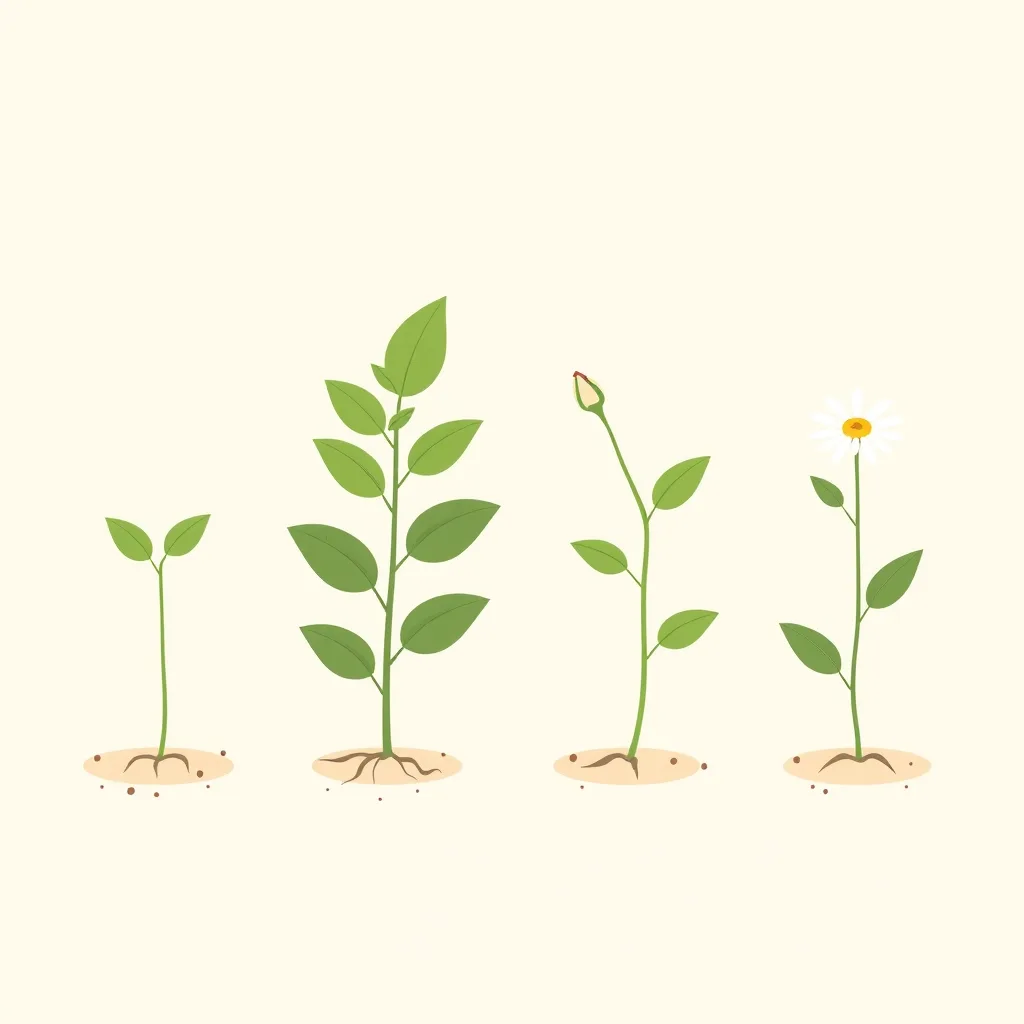
Flower growth stages run from germination to seed set, but the first two of those six stages do not move at one speed. Iowa State University Extension times germination at 5 to 7 days for zinnia and 14 days for wax begonia, and the interval from sowing to planting size runs 5 weeks for zinnia against 10 to 12 weeks for wax begonia, roughly double to nearly triple on those two stages, the only ones either source dates. This spoke sits inside the plant growth stages hub, which tracks the same six-part organizing frame across other garden crops.
Germination, seedling, vegetative growth, budding, flowering, and seed set carry a garden annual through its year here. The sixth stage is not the end of a fixed sequence, and UGA Extension names three reasons it may not happen. A gardener can deadhead, which UGA says “not only prevents the formation of seeds but stimulates additional flowering”; UGA names aster, calendula, dahlia, foxglove, geranium, hollyhock, marigold, purple fountain grass, salvia, snapdragon, tithonia, and zinnia as the annuals that should generally get this treatment, two of which, zinnia and snapdragon, are also on Iowa State’s germination table below. Beyond that choice, some modern varieties are “self-cleaning” and others are sterile and produce no seeds at all. Seed set does not simply follow flowering for any of these three reasons; it competes with it or was never reachable at all.
How Long Do Flower Growth Stages Take From Seed to Bloom?
The published record covers the front half of this question and stops short of the back half. Iowa State’s germination table names six common annuals with a days-to-germination figure and a weeks-sowing-to-planting figure for each: ageratum at 7 to 10 days and 8 weeks, snapdragon at 7 to 14 days and 8 to 10 weeks, wax begonia at 14 days and 10 to 12 weeks, zinnia at 5 to 7 days and 5 weeks, petunia at 7 to 10 days and 8 to 10 weeks, and impatiens at 10 to 14 days and 8 to 10 weeks.
UGA Extension’s Bulletin B954, on flowering annuals for Georgia gardens, was checked by name for a sowing-to-bloom timing figure and gives none. It describes annuals blooming “continuously from spring until frost kills them in the fall” without dating when flowering itself begins. So the honest seed-to-bloom answer, for the species Iowa State covers, is 5 to 14 days to germinate, 5 to 12 more weeks to reach planting size, and an unsourced stretch after that before the first bloom opens.
What Happens If a Flowering Plant Skips the Budding Stage
Iowa State’s germination table stops at planting size, and UGA’s B954 does not name or number any growth stage at all. Neither one describes a flowering plant skipping the budding stage, or any stage being bypassed.
What UGA does document is close to the reverse: a plant kept from moving past flowering rather than a plant that jumps past budding. Removing a spent flower “not only prevents the formation of seeds but stimulates additional flowering,” UGA writes, which holds the plant in the flowering stage instead of letting it advance toward seed set. Read backward, it still argues against a rigid one-way sequence: if the last stage can be prevented by a gardener’s own hand, the six were never a fixed conveyor belt.
6 Flower Growth Stages That Apply Across Most Garden Annuals
Neither Iowa State’s germination table nor UGA’s B954 names or numbers a flower growth-stage model. The six stage names below are this site’s own organizing frame, not a published taxonomy, built around the figures the two programs do publish rather than invented in between them.
6-Stage Flower Growth Timeline, Iowa State and UGA Extension Sourced Anchors
| Stage | Stage name | General timeframe | Visible sign |
|---|---|---|---|
| 1 | Germination | 5 to 7 days (zinnia, fastest) to 14 days (wax begonia, slowest), Iowa State, varies by species | Seed coat splits, first sprout breaks the soil surface |
| 2 | Seedling | Inside Iowa State’s 5 to 12 week sowing-to-planting window; not broken out as its own day count | First true leaves open above the seed leaves |
| 3 | Vegetative growth | Not published by Iowa State’s germination table or UGA’s B954 | Stem and leaf growth continues, no flower bud yet visible |
| 4 | Budding | Not published by Iowa State or UGA | First flower buds appear at the stem tips |
| 5 | Flowering | UGA: annuals bloom “continuously from spring until frost kills them in the fall”; no stage-start date published | Petals open |
| 6 | Seed set | Optional. UGA: prevented by deadheading in the annuals it names, skipped on its own in self-cleaning varieties, or unreachable in sterile ones | Spent flower head begins forming seed if left unremoved and the variety is fertile |
Stages 3 and 4 carry no day count from either program checked here, the clearest sign that vegetative growth and budding run on the plant’s own signal rather than a fixed number of days. Stage 1 carries the widest range because it is really six species’ figures collapsed into one row; read the full spread in the section above rather than treating 5 to 14 days as one species’ figure. Stage 6 is marked optional because UGA documents three separate ways it may not happen, a gardener deadheading, a self-cleaning variety, or a sterile one, not because seed set is rarer than the other five. The same six-part shape echoes elsewhere in this pillar: watermelon growth stages run a comparable germination-to-fruit-set sequence on a far longer clock.
‘Deadheading’ and ‘Seed Set’ Explained in Plain English
Deadheading is removing a flower once it has faded, before it can form seed. UGA Extension describes what that does: it “not only prevents the formation of seeds but stimulates additional flowering,” so the same cut that stops one outcome starts another.
Seed set is the stage a flower moves into if it is left alone: the spent bloom’s base swells and develops seed instead of opening a new flower. The two terms describe the same fork in the road from opposite directions. Deadhead, and the plant stays in the flowering stage. Leave the flower, and it moves into seed set. Neither is a mistake; they are two different choices about which of the six stages a plant spends the rest of its season in.
How Many Weeks Between Budding and Full Bloom for Most Flowers?
No checked source gives it. UGA’s B954 was asked by name for how long a bud takes to open and names no figure, and Iowa State’s germination table stops at planting size, well before any bud has formed. This article does not fill that gap with a derived number, because nothing in either source anchors a derivation the way Iowa State’s germination and planting columns anchor the ranges used elsewhere on this page.
What is published around it is the shape of the season rather than a bud-to-bloom day count. UGA describes annuals blooming “continuously from spring until frost kills them in the fall” once flowering starts, and pansies specifically producing “some flowers in fall and winter followed by peak flowering in spring.” Both describe how long flowering lasts once it begins, not how long a bud takes to get there.
Annual vs Perennial Flower Growth Stages: Same Steps, Different Clock
UGA’s own description of an annual’s arc, blooming “continuously from spring until frost kills them in the fall,” is the whole clock in one sourced clause: germinate, grow, bud, flower for a season, and stop at frost. The bulletin’s pansy line complicates the tidy version even inside annuals. Pansies “produce some flowers in fall and winter followed by peak flowering in spring,” so one species checked here does not stop at frost the way UGA’s general description implies for annuals as a class.
This article did not verify a comparable perennial timeline from a named source. The general pattern, not a dated figure, is that a perennial surviving winter by root or crown does not restart every stage from germination each spring the way a reseeded annual does. Check a specific species’ own extension page rather than applying an annual’s clock to it.
Does Every Flower Really Pass Through All 6 Growth Stages Every Year?
No, and UGA Extension documents three reasons stage six can be skipped, and only one is a gardener’s choice. First, deadheading the named annuals above (zinnia and snapdragon among them) “not only prevents the formation of seeds but stimulates additional flowering.” Second, some modern varieties are “self-cleaning”: spent flowers drop on their own. Third, some varieties are sterile and produce no seeds, so stage six was never reachable for that plant.
That reframes the six-stage list at the top of this page. It is not a guaranteed itinerary every plant completes once a year; it is a sequence with up to three separate exits. A bed of the named annuals, deadheaded all season, can cycle between stages four and five, budding and flowering, and never reach stage six. The plant is not stalled and nothing has gone wrong. It is doing exactly what UGA describes: flowering again instead of setting seed, or in a self-cleaning or sterile variety, never carrying that choice at all.
Why Flower Growth Stages Sometimes Stall Before Budding
Iowa State’s post-germination note is the sourced material for this stretch: “nearly all seedlings will grow best with daytime temperatures between 65 and 70°F and nighttime temperatures a few degrees cooler.” Neither Iowa State’s table nor UGA’s B954 ties a stall specifically to the run-up to budding, so what follows is the closest sourced explanation rather than a direct one.
A seedling growing outside that 65 to 70°F daytime range sits outside Iowa State’s own best-case window, and slower vegetative growth is a plausible drag on everything downstream, including how soon a bud appears. Light matters earlier still. Iowa State’s own legend splits the six species into those needing light to germinate and one, zinnia, needing darkness instead, so a stall can start at the seed-covering step, before any bud is in view.
Sow, Transplant, or Direct Seed: How Start Method Shifts Flower Stages
Iowa State’s own weeks-sowing-to-planting column is this section already published: the interval between putting seed in a tray and setting a plant outside runs from 5 weeks for zinnia to 10 to 12 weeks for wax begonia, with ageratum, snapdragon, petunia, and impatiens spread across 8 to 10 weeks between those two ends.
UGA’s B954 answers the start-method question directly: “Three options are available: (1) direct seeding in prepared beds, (2) seeding early indoors with subsequent transplant to the landscape, and (3) purchase of commercially grown plants.” Its general rule of thumb for indoor seeding is “most annuals can be seeded indoors six to eight weeks before the last frost,” a species-blind range set below several of Iowa State’s own figures above (wax begonia needs 10 to 12 weeks; four others reach or exceed 8), so a species’ own Iowa State figure should override the general rule when one is published.
A transplant moves through germination and early seedling growth under controlled conditions, then re-enters the outdoor clock near the point Iowa State’s column ends. A direct-seeded flower runs germination and seedling growth outdoors from day one, exposed to whatever the bed’s own soil temperature happens to be, which is why poppy, typically sown straight into the ground, gets its own dedicated timing page instead of borrowing this one’s figures.
None of Iowa State’s figures here are tied to a USDA hardiness zone number, because zone numbers sort winter cold, not how fast a spring seed tray warms up. A reader’s own last frost date decides when either method actually goes into the ground, and that date is worked through on the planting calendar hub, sourced to NOAA and NWS station normals rather than a zone number.
Frequently Asked Questions
Do all flowers move through the same six growth stages? The six stages here are this site’s own organizing frame, not a taxonomy either checked source publishes. Every species fits that shape, but not at the same pace: Iowa State’s germination and sowing-to-planting figures span 5 to 14 days and 5 to 12 weeks across six common annuals, so “same stages” does not mean the same clock.
Can a flowering plant skip straight from seedling to budding? The sourced record does not address skipping a stage forward. What UGA Extension documents runs the other direction: deadheading returns a plant to the flowering stage instead of letting it move toward seed set, a stage held back rather than skipped ahead.
Does deadheading extend a plant’s blooming stage? Yes, per UGA Extension. Removing a spent flower before it can form seed “not only prevents the formation of seeds but stimulates additional flowering,” which keeps the plant in the flowering stage rather than letting it move on to seed set.
Why do some annuals bloom faster than others from seed? Iowa State’s germination table shows the front half of the answer: zinnia germinates in 5 to 7 days and reaches planting size in 5 weeks, while wax begonia takes 14 days to germinate and 10 to 12 weeks. A faster start compounds into an earlier planting date, though the table stops there and does not carry a bloom date forward.
Do perennial flowers restart at the germination stage every spring? Generally not the way a reseeded annual does, since an established perennial typically regrows from a surviving root or crown rather than germinating from seed each year. This article did not verify a dated perennial figure from a named source, so treat that as the general pattern, not a sourced timeline, and check a specific species’ own extension page for its regrowth timing.
Sources
- Iowa State University Extension and Outreach, Germination Requirements for Annuals and Vegetables: germination temperature, light requirement, days to germination, and weeks sowing to planting for six common annuals.
- University of Georgia Extension Bulletin B954, Flowering Annuals for Georgia Gardens: deadheading’s effect on flowering and seed formation, the named annuals that should generally be deadheaded, self-cleaning and sterile varieties, the annual bloom season, pansy’s fall-to-spring flowering pattern, and the three start-method options with a general indoor-seeding timeframe. Written for Georgia gardens; used here for its stage-level description of deadheading and bloom season, not for zone-specific planting dates.
Last verified: 2026-08-17, against Iowa State Extension’s germination requirements page and UGA Extension Bulletin B954.