
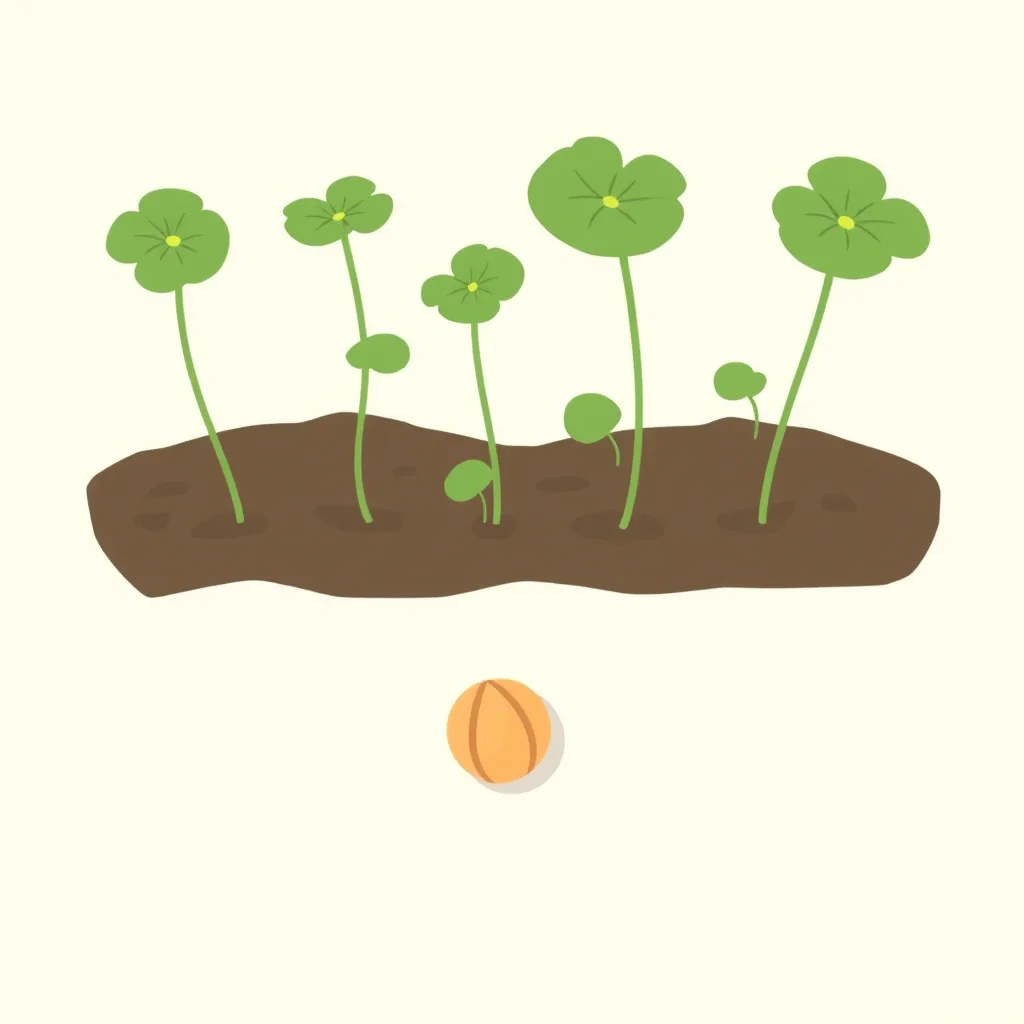
Nasturtium germination time runs 7 to 10 days per University of Wisconsin Horticulture Extension and 10 to 14 days per Iowa State University Extension and Outreach, two named programs whose ranges overlap only at day 10. Soaking the seed for up to eight hours, the cap given by UC Master Gardeners of Napa County, is a step Wisconsin also describes as helping, without either source publishing a separate faster day count for soaked seed. This plant growth stages spoke covers both ranges and UC Napa’s soaking cap rather than flattening the disagreement into one number.
Sow, Soak, or Direct Seed Nasturtiums for Faster Germination
Nasturtium seed works with two paths, and soaking sits inside both rather than as a third option. To direct seed nasturtium, University of Wisconsin Horticulture Extension times outdoor sowing to “late spring to early summer once all danger of frost has passed.” To start indoors instead, sow nasturtium seeds into peat pots “4 to 6 weeks before the date of the last expected spring frost,” then plant nasturtium seedlings out once frost passes.
Wisconsin states plainly that soaking “for a few hours or overnight before planting can improve germination,” and UC Master Gardeners of Napa County treats it as an optional step with one condition, covered under the fifth H2 below. Soaking is the one lever a grower controls, since frost timing and soil warmth are set by the calendar.
When Is Soil Warm Enough to Plant Nasturtium Seeds?
Soil is warm enough once all danger of frost has passed and the ground has had time to warm, not on a fixed calendar date. University of Wisconsin Extension times outdoor sowing to “late spring to early summer once all danger of frost has passed,” and University of Maryland Extension puts the same rule differently: “Sow seeds outdoors after the danger of frost has passed and the soil has had a chance to warm up.”
Neither program attaches a degree figure to that warmth. Iowa State lists nasturtium’s germination temperature at 65 to 70°F, but that table defines its own column as “the ideal air temperature for germination,” not a soil reading. No program checked for this article publishes a soil-temperature threshold for nasturtium seed, a gap this site’s bermuda grass germination guide ran into from the other direction, where a real number answered a different task entirely. One exception: Deschutes County (OSU) Extension, via Ask Extension, told one reader “the soil temperature should be between 60 and 80 degrees for optimum growing conditions,” an office answer, not a published factsheet figure.
The practical version of this answer is a count-back, not a threshold. Find a local last-frost normal from a NOAA or NWS station, wait for it to pass, and give the soil a few added warm days, since frost clearing and soil actually warming are not the same moment.
Why Nasturtium Seeds Are Not Germinating Even After Soaking
A soak gone too long is a documented cause, not a guess. UC Master Gardeners of Napa County states it directly: “Some gardeners like to soak nasturtium seeds before planting to speed germination. If you do, remember to soak them no longer than eight hours to avoid losing your seed to rot.” Seed left in water past that point can rot before it reaches soil, producing exactly the symptom a grower reports as failed germination.
Cold soil is a second cause: Iowa State’s 65 to 70°F figure is air temperature, not soil, and a bed that has not genuinely warmed will slow any seed. Seed age is a third possibility this article cannot size: a seed-viability chart from University of Illinois Extension and Colorado State University fact sheet 7.221 were checked by name for nasturtium, and neither lists the species, an absence this site’s cilantro germination timeline ran into for its own crop’s day count.
The rot risk from over-soaking is the most actionable of the three, fully inside the grower’s control. The fix UC Napa names is not a product or a treatment: a shorter soak, in plain water, stopped at eight hours.
Nasturtium Planting Calendar, Late Spring Through Early Summer
University of Wisconsin Extension anchors outdoor sowing to “late spring to early summer once all danger of frost has passed,” which in much of the northern and midwestern United States lands in May or June depending on the local frost normal. Clemson HGIC’s Growing Annuals factsheet gives South Carolina a narrower, earlier window, “seed in early spring,” consistent with a state whose frost risk clears weeks ahead of Wisconsin’s. The month is not fixed nationally; it follows each region’s own last frost, which is why this article points to a NOAA or NWS station rather than one national date. University of New Hampshire Extension confirms Wisconsin’s 4 to 6 week indoor lead time independently. In warm, mild climates the calendar effectively never closes: Wisconsin notes nasturtium there “blooms and seeds year round and may be invasive,” while “reseeding is not a problem in cold climates.”
How Long to Soak Nasturtium Seeds Before You Sow? Stop at Eight Hours
Eight hours is the published ceiling, not a suggestion to stretch. UC Master Gardeners of Napa County states it directly: soak nasturtium seed “no longer than eight hours to avoid losing your seed to rot.” University of Wisconsin Extension describes the step more gently, “soaking the seed for a few hours or overnight before planting can improve germination,” with no hard cutoff of its own. Read together, a few hours covers the low end and eight hours is the documented stopping point past which the benefit turns into a risk.
Whether any pre-treatment is needed at all is genuinely disputed between two Ask Extension answers. One, from 2017, calls nicking plus an overnight soak unnecessary “to speed germination.” Another, answered by Clackamas County (OSU) Extension in 2018, takes the opposite view: “it is recommended that you both apply the nail file, and soak the seeds before planting.” Neither office resolves the other. Nicking, where used, is a physical scoring of the seed coat, not a product step, and changes nothing about the eight-hour cap either way.
How Long Do Soaked vs Unsoaked Nasturtium Seeds Take to Sprout?
Two named programs publish two different ranges, agreeing at exactly one point. University of Wisconsin Extension gives 7 to 10 days, restated elsewhere on the page as “a week to ten days depending on soil temperature.” Iowa State’s germination table gives 10 to 14 days for the same species. The two overlap only at day 10: a seedling up on day 8 is on schedule by Wisconsin’s figure and early by Iowa State’s, while one still below ground on day 12 sits inside Iowa State’s window and already late by Wisconsin’s.
Neither program’s range is broken out by soaking status, but for different reasons. Wisconsin’s soaking sentence, that it “can improve germination,” sits apart from its day-count figure, never combined into a separate faster number for soaked seed. Iowa State’s range does not mention soaking at all. What is sourced is that soaking is described as helping only within Wisconsin’s published range, not as producing its own distinct count, which the comparison table below reports directly.
Nasturtium Seeds Planted Too Deep: What Happens Next
“Too deep” has no single published number, because the programs that give a sowing depth do not agree. Wisconsin calls for seed sown “½ inch deep,” noting the seed needs “darkness to germinate.” UC Napa gives a full inch instead: “plant nasturtium seeds one inch deep.” Iowa State’s legend for species needing cover puts the medium at “usually 1/4 to 1/2 inch,” precise depth left to the seed packet. Across the three, the sourced range runs a quarter inch to a full inch, so seed genuinely planted too deep is buried well past an inch, not anywhere inside that spread.
The darkness requirement explains why depth matters at all. Iowa State’s table codes nasturtium “D,” its legend defining that letter as requiring darkness for germination, matching Wisconsin’s own parenthetical. Seed sown too shallow risks light reaching it before it sprouts; seed sown well beyond an inch has a longer push through soil, which slows or stalls emergence even with darkness already covered. The two failure modes sit on opposite sides of the same published spread, not one fixed correct depth.
Nasturtium Germination Time Chart, Soaked vs Unsoaked Table
The table below works from what University of Wisconsin Extension and Iowa State University Extension and Outreach each publish, rather than inventing a faster count for soaked seed that neither program states.
Nasturtium Germination Comparison, Wisconsin and Iowa State Sourced
| Seed Prep | Days to Germination Range | Germination Consistency Note |
|---|---|---|
| Soaked, up to 8 hours in plain water (UC Napa’s cap) | 7 to 14 days, the same published range as unsoaked seed | Wisconsin states soaking “can improve germination” but does not attach a separate day count to soaked seed specifically |
| Unsoaked, sown dry | 7 to 10 days (Wisconsin) to 10 to 14 days (Iowa State), overlapping only at day 10 | Two programs give two different baseline ranges; neither ties its figure to soaking status |
Neither program publishes a faster range specifically for soaked seed. What is sourced is that soaking is described as helping within the same published window, and that window already differs by roughly a week depending on which program a grower checks.
Frequently Asked Questions
Does nasturtium seed size vary by variety? No figure is published for this by any program checked. University of Wisconsin Extension’s long cultivar list covers flower color, height and habit for many varieties, but never a seed-size number.
Can nasturtiums be started indoors in trays before the last frost? Yes, four to six weeks before the last frost, per University of Wisconsin Extension and University of New Hampshire Extension; Iowa State’s own germination table gives a slightly different 5 to 6 weeks for the same step. The catch: that same table footnotes nasturtium as a species that does “not transplant well” and should be “seeded directly into peat pots,” not loose trays.
Do nasturtium seedlings need to be thinned after sprouting? The sourced spacing figures are set at sowing time, not as a thinning step. Wisconsin calls for seed 10 to 12 inches apart, and UC Napa gives about ten inches, the alternative to thinning later.
Why do nasturtium seeds float in water before soaking? Not addressed by the programs checked for this article. University of Wisconsin Extension and UC Master Gardeners of Napa County both cover soaking, but neither describes what a floating or sinking seed means beforehand.
Is bush type nasturtium germination different from vining type? The split described in the sources checked is about mature growth habit, not sprouting speed. Wisconsin distinguishes bush and vining nasturtium only by whether the plant forms “low mounds” or trails “up to 3 feet,” with no separate germination timeline attached.
Sources
- University of Wisconsin Horticulture Extension, Nasturtium, Tropaeolum species, sowing, soaking, depth, spacing, darkness, self-seeding
- Iowa State University Extension and Outreach, Germination Requirements for Annuals and Vegetables, 10 to 14 day range, air-temperature definition, darkness code, depth legend, transplant footnote
- UC Master Gardeners of Napa County, Nasturtiums, eight-hour soak cap and rot risk, depth and spacing
- University of Maryland Extension, Nasturtium, frost-and-soil-warmth sowing rule
- University of New Hampshire Extension, indoor-start lead time
- Clemson HGIC, Growing Annuals, early-spring South Carolina window
- Ask Extension #395578, nicking and soaking, necessity
- Ask Extension #444028, Clackamas County (OSU) Extension, nicking and soaking, recommended
- Ask Extension #858893, Deschutes County (OSU) Extension, county-level soil temperature
- University of Illinois Extension, Seed Viability and Germination, checked for a nasturtium row, species not listed
- Colorado State University Extension, Storing Vegetable and Flower Seeds, fact sheet 7.221, checked for a nasturtium row, species not listed
Last verified: 2026-08-18, against University of Wisconsin Horticulture Extension, Iowa State University Extension and Outreach, UC Master Gardeners of Napa County, University of Maryland Extension, University of New Hampshire Extension, Clemson HGIC, three Ask Extension threads, and the University of Illinois and Colorado State seed-viability charts.