
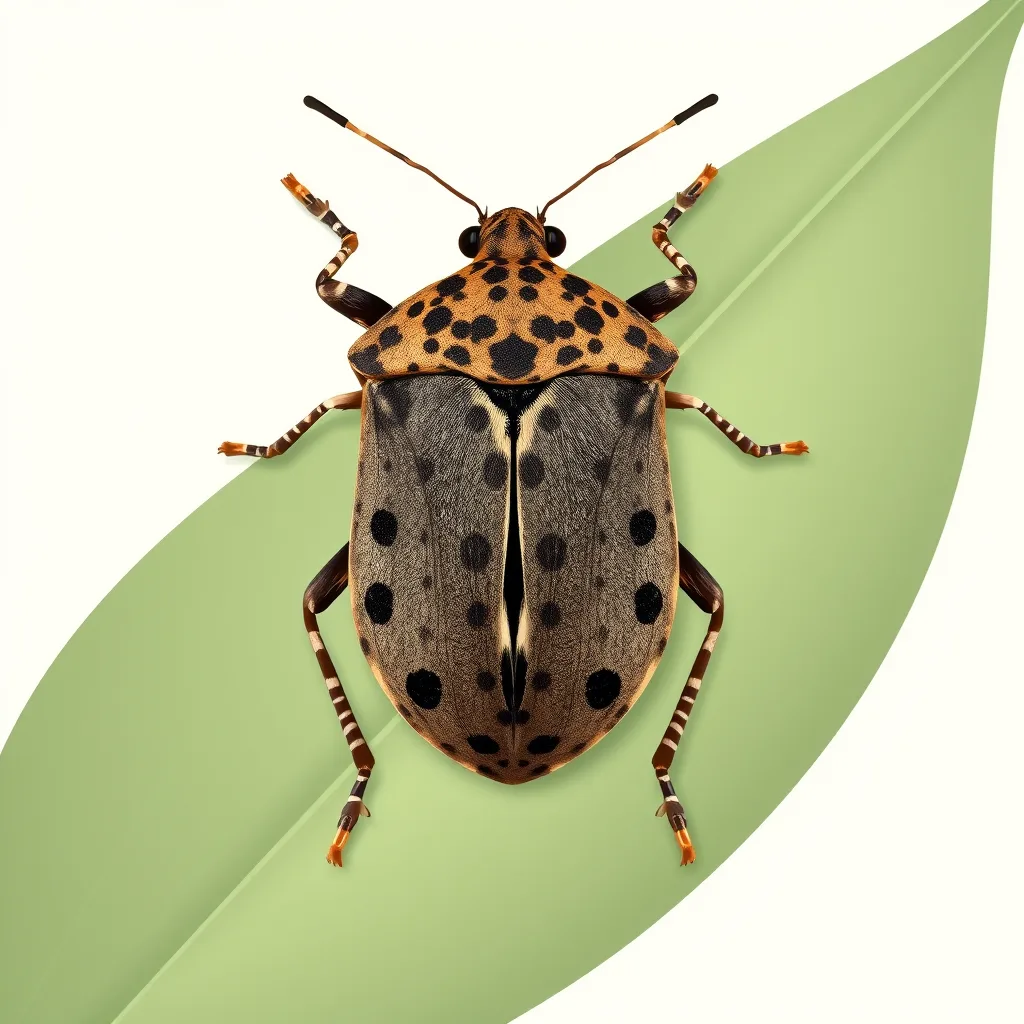
A stink bug’s development runs on two separate calendars. Adults that spent winter dormant re-emerge each spring to mate outdoors, while a new generation of adults heads the opposite direction each fall, moving indoors to overwinter in turn. Between those two points, egg to adult, the brown marmorated stink bug (Halyomorpha halys) takes roughly 40 to 60 days to develop under summer conditions, according to the University of Florida IFAS. That range covers five separate nymph stages, not one long larval period, which is the real reason the timeline is worth breaking down. This site’s broader reference on household and garden pest life cycles covers the same seasonal split across other insects.
How Long Does a Stink Bug Take to Go From Egg to Adult?
Egg to adult, a stink bug’s life cycle spans roughly 40 to 60 days, per University of Florida IFAS EDIS publication EENY346, depending on temperature and photoperiod. That is the sourced figure for how long the stink bug life cycle takes, and it covers the full brown marmorated stink bug lifespan through five nymph stages, not just one.
StopBMSB, the USDA-NIFA multistate project on the species, gives a second version of the same span: about 538 degree-days from egg to adult, plus another 148 degree-days before a mated female begins laying eggs. A degree-day figure and a calendar-day figure describe the same biology from different angles, and the actual time in a given location depends on how fast that location accumulates degree-days, which is part of why UF/IFAS’s range is wide. The instar table below breaks that span into its five nymph stages by size and behavior, though neither source breaks it down by instar; the table below does, from a third source, in degree-days rather than calendar days.
What Happens If Stink Bug Eggs Are Left on Garden Plants
Left undisturbed on a garden plant, stink bug eggs hatch into first-instar nymphs that stay close to the empty eggshells rather than scattering right away. StopBMSB reports that newly hatched nymphs remain grouped in that spot instead of spreading across the plant, and UF/IFAS confirms the pattern with a specific trigger: first instars “may aggregate around the egg clutch before molting and dispersing to feed.” Dispersal happens at the molt into the second instar, not at hatching itself.
Once that first molt occurs, the population spreads across the plant as nymphs disperse to begin feeding individually rather than staying in the tight cluster they hatched into. A single egg mass, laid on the underside of a leaf in a clutch of roughly 28 eggs per StopBMSB, is the starting point for a nymph population that grows more spread out with each successive molt, following the same five-stage instar sequence covered next.
5 Nymph Instar Stages in the Stink Bug Life Cycle
A brown marmorated stink bug passes through five nymph instar stages between hatching and its final molt into a winged adult, per StopBMSB. Each instar looks different from the last: size increases, color shifts, and wing buds develop further at every molt, per UF/IFAS. The table below combines size, color and behavior detail published across three programs: StopBMSB, UF/IFAS EDIS EENY346, and Penn State Extension’s brown marmorated stink bug page, read here through a Wayback Machine capture dated 2022-12-26 because the live Penn State URL returned an error to this site’s research tool.
Stink Bug Nymph Instar Stages, Size, Color and Behavior
| Instar | Duration Range (degree-days) | Size / Color Change | Behavior Note |
|---|---|---|---|
| 1 | 54 DD from egg-laying, cumulative | About 2.4mm long; black head and thorax, orange-red abdomen, and reddish eyes | Clusters around the egg mass rather than dispersing |
| 2 | 107 DD cumulative; 53 DD span (ours) | Loses most of the orange-red color and darkens; spiny projections appear on the thorax margins; wing buds begin forming | Molts out of the cluster and disperses to begin feeding |
| 3 | 216 DD cumulative; 109 DD span (ours) | Continues darkening toward black-to-gray; wing buds likely enlarge further, following UF/IFAS’s general wing-bud trend rather than an instar-3-specific statement | Actively feeding and mobile across the plant |
| 4 | 303 DD cumulative; 87 DD span (ours) | Black-to-gray coloring; spines along the shoulder margins and white banding on the legs and antennae grow more visible | Actively feeding and mobile; wing buds nearing full development |
| 5 | 394 DD cumulative; 91 DD span (ours); 520 DD cumulative to adult, 126 DD span (ours) | About 12mm long, the largest nymph stage; abdomen progresses toward off-white with reddish spots, per Penn State; leg and antenna banding fully visible | Last stage before the final molt into a winged adult |
None of the five BMSB-focused extension sources read for this article, StopBMSB, UF/IFAS EENY346, the Penn State archive above, University of Maryland Extension, and Oregon State University’s BMSB program page, breaks the egg-to-adult span down by individual instar in calendar days. The degree-day figures above come from Rebek et al. (2023), a peer-reviewed study of a New Jersey population; the paper also studied an Oregon population but does not give this breakdown for it. The cumulative totals, 54, 107, 216, 303, 394 and 520 DD from egg-laying, are the paper’s own numbers; the per-instar spans in the table are this article’s own subtraction. These degree-days are not converted to calendar dates here because they accumulate at different rates by location, so the same instar takes different calendar time in different places. The paper’s 520 DD egg-to-adult total sits within about 3 percent of StopBMSB’s independently published 538 DD.
‘Instar’ Explained in Plain English for Stink Bug Stages
An instar is the stage between two molts. A stink bug nymph does not grow smoothly the way a mammal does. It grows in steps, and each step ends with the nymph shedding its outer skin to reveal a slightly larger, slightly different-looking version of itself underneath. The five nymph stages in the table above are instar 1 through instar 5, each one the period between one molt and the next.
The word shows up constantly in extension literature because it is the standard unit entomologists use to describe insect development. For a stink bug specifically, moving from one instar to the next also triggers the behavior changes covered elsewhere on this page, most notably the shift from clustering near the egg mass in instar 1 to dispersing and feeding from instar 2 onward.
How Many Generations of Stink Bugs Occur in One Summer?
Most of the brown marmorated stink bug’s North American range sees one to two generations per year, per UF/IFAS. Warmer climates can support more; UF/IFAS notes that several generations per year are possible in the warmest parts of the range. Penn State’s archived page gives a regional example at the cooler end: Pennsylvania probably sees a single generation most years, though a warm spring and summer can permit a partial second one.
That range, one to two generations across most of the country and more where summers run long and warm, is why the instar table’s 40-to-60-day timeline does not map onto every backyard the same way. A shorter, cooler-summer region completes one full pass through the five nymph stages before fall. A longer, warmer one can complete two.
Spring Stink Bugs vs Fall Stink Bugs: Same Insect, Different Behavior
The same adult stink bug behaves differently in spring than it does in fall, and the difference is about direction and purpose. In spring, StopBMSB describes overwintered adults emerging and beginning to mate roughly two weeks after emergence, then spending the summer feeding and laying the egg masses that produce the season’s nymphs. Penn State’s archived guidance gives a regional window for the Mid-Atlantic: adults emerge in spring, late April to mid-May, and mate and lay eggs from May through August.
In fall, a new generation of adults does the opposite. Rather than mating and laying eggs, they stop reproducing and begin moving toward shelter, per Penn State’s archived page. University of Maryland Extension’s description matches it: adults congregate in late summer and early fall and actively seek overwintering sites. Same species, same five-instar development behind them, but the fall generation’s job is finding shelter, not starting a new brood.
Does the Stink Bug Life Cycle Really Restart Indoors in Winter?
No. Adults that move indoors for winter go dormant there; they do not start a new generation. Penn State’s archived guidance states this directly: “The stink bug will not reproduce inside structures.” UF/IFAS explains the mechanism behind that stillness. Shortening fall daylength triggers winter diapause, during which “adult reproductive activity ceases,” and only adults, not eggs or nymphs, survive winter this way.
Spring’s longer days and warmer temperatures end that diapause, per UF/IFAS, and reproduction starts again outdoors once adults have re-emerged, not before. The life cycle does not restart indoors. It pauses there, and resumes outside.
Why Stink Bug Nymphs Sometimes Disappear Between Instar Stages
A nymph that seems to vanish between one instar and the next is usually doing one of two ordinary things, not actually disappearing. The first is dispersal: as covered above, first-instar nymphs cluster tightly around the egg mass, then scatter across the plant once they molt into the second instar and begin feeding independently, per UF/IFAS. A count taken before that molt and a count taken after it can look like a population drop even though nothing died. The nymphs simply spread out.
The second is ordinary mortality. Insects with several nymphal stages lose individuals to generalist predators and to the molting process itself at a normal background rate. UF/IFAS, StopBMSB and Penn State’s archived page describe general nymph development, but none names a specific predator or publishes a mortality percentage, so no rate is given here. Some loss between instars is typical development, not a sign anything unusual happened, and the dispersal explained above accounts for a meaningful share of what looks like disappearance.
Spot, Track, or Count: Timing Signs of Each Stink Bug Stage
Spot, track and count all lean on the same reference point, the instar table above, to place a nymph at a specific stage. Spotting means comparing size and color. A small orange-red nymph clustered on a leaf underside is a first instar; a larger nymph with off-white, red-spotted coloring and fully banded legs is a fifth instar nearing its final molt into a winged adult.
Because a stink bug develops through five gradual nymph instars rather than a small number of sharply distinct stages, tracking progress means watching size and color shift a little at each molt, not spotting a sudden change in body form. That differs from an insect with a pupal stage, where one stage looks nothing like the next, the way the pantry moth life cycle, egg to adult moves through four discrete stages rather than five gradual ones. Counting means noting how many instars separate what is seen now from an adult: a first-instar sighting points to four more molts ahead, a fifth-instar sighting points to one. The 40-to-60-day total from the first section is the only calendar figure the sources support for that whole span.
When Fall Stink Bugs Start Moving Indoors by Region
Fall indoor movement is documented with a month-level range for one part of the country and is not documented with that same precision everywhere the species now occurs. The table below reports what Penn State’s archived page and University of Maryland Extension actually publish.
When Adults Typically Move Indoors for Winter, by US Region
| US Region | Typical Month Range Adults Move Indoors | Source |
|---|---|---|
| Mid-Atlantic / Northeast (PA, MD, NJ, VA and similar) | September through October (Penn State); late summer into early fall, more broadly (UMD) | Penn State Extension, archived page; University of Maryland Extension |
StopBMSB’s state-by-state tracking, sourced to the University of Georgia’s EDDMapS, places the species in 47 states, with established populations in 10 and nuisance-level populations in 21 more. Oregon State University’s BMSB program page covers Oregon’s distribution and economic impact but does not give a month range for fall indoor movement there, and no Midwest-specific month range turned up either. The species’ range is now far wider than its original Mid-Atlantic foothold, but published month-level fall-movement timing has not caught up to that wider range yet.
Frequently Asked Questions
Do stink bug nymphs stay near the egg mass after hatching? Yes, briefly. First-instar nymphs cluster around the egg mass rather than dispersing right away, per StopBMSB, and UF/IFAS specifies the trigger: they aggregate near the empty eggshells until they molt into the second instar, then disperse to begin feeding across the plant.
Can stink bug nymphs fly like adults do? Not as far as the source describes it. Wing buds develop gradually across the nymph stages, per UF/IFAS, but UF/IFAS does not state outright when those buds become flight-capable. Standard hemimetabolous insect development, where wings only work at the adult stage, supports treating nymph flight as unlikely, though this is an inference from the wing-bud description rather than a direct statement from UF/IFAS.
Why do stink bugs cluster on sunny sides of houses in fall? They are seeking warmth on their way to overwintering shelter. University of Maryland Extension describes adults congregating on warm, elevated surfaces in late summer and fall as part of the search for a place to spend the winter, a basking behavior tied to temperature rather than anything specific about the sunny side itself.
Does a cold winter reduce the stink bug population the next summer? UF/IFAS and StopBMSB describe the overwintering mechanism, only adults survive winter, and survival depends on finding adequate shelter, but neither publishes a figure connecting winter severity to the following summer’s population size. That link is not quantified in the sources checked for this article.
See also the wasp life cycle, queen to colony.
Sources
- StopBMSB, “Life Stages”: USDA-NIFA multistate BMSB project; egg-to-adult degree-day totals, egg mass size and placement, five nymphal instars, early-instar clustering, spring emergence and mating timing.
- StopBMSB, “Where Is BMSB: State-by-State”: distribution across 47 states, sourced to the University of Georgia’s EDDMapS.
- University of Florida IFAS, EDIS EENY346/IN623, “Brown Marmorated Stink Bug”: egg-to-adult day range, instar color and size progression, aggregation and dispersal trigger, winter diapause mechanism, generations per year.
- Penn State Extension, “Brown Marmorated Stink Bug,” read via Wayback Machine capture dated 2022-12-26: egg and instar size detail, Pennsylvania generation count, spring emergence and mating window, fall shelter-seeking window, indoor non-reproduction statement.
- University of Maryland Extension, “Brown Marmorated Stink Bug”: adults seeking shelter in the fall, and checked for per-instar duration and indoor-movement timing.
- University of Maryland Extension, “Tips for Dealing With Brown Marmorated Stink Bugs”: fall congregation, warm-surface basking behavior, and overwintering-site seeking.
- Oregon State University, BMSB program page: Oregon distribution and economic context; checked for a fall indoor-movement month range and per-instar duration, neither of which the page publishes.
- Rebek et al., “Temperature-Dependent Life Table Parameters of Brown Marmorated Stink Bug, Halyomorpha halys (Stål) (Hemiptera: Pentatomidae) in the United States,” Insects 2023, 14(3):248: peer-reviewed, open access; cumulative degree-days to each instar for a New Jersey population.
Last verified: 2026-08-18, against StopBMSB’s Life Stages and State-by-State pages, UF/IFAS EDIS EENY346, Penn State Extension’s brown marmorated stink bug page (Wayback capture dated 2022-12-26), University of Maryland Extension and its Tips page, Oregon State University’s BMSB program page, and Rebek et al. 2023 in Insects.