
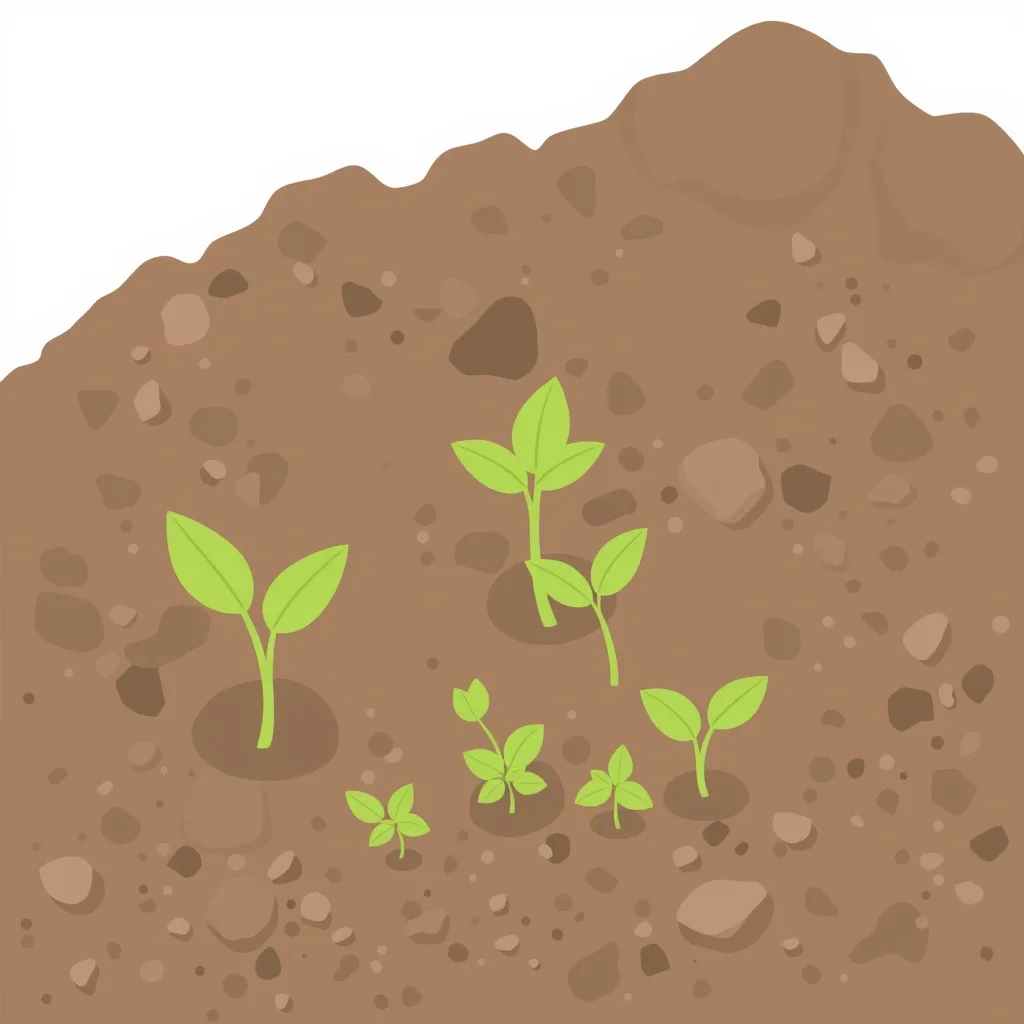
Poppy seed sown outdoors takes 2 weeks to emerge in warm weather and 4 weeks in cool weather, according to Utah State University Extension. That is not a range of uncertainty. It is a temperature effect, and the cool end of it is the slow end. This article covers ornamental garden poppies, inside this plant growth stages cluster, and draws its seedling-timing figures from a source built for a different purpose, disclosed below.
One source used here needs a plain flag before anything else. Utah State’s Seed Poppy in the Garden is written about Papaver somniferum, and that guide’s own purpose is a different one from this article’s. Nothing about seed harvest, pods, or any use of the plant appears anywhere in this article. Its emergence and thinning figures are usable because germination and early growth work the same way regardless of what the seed is grown for, and those are the only figures pulled from it. For the flowers themselves, University of Illinois Extension names three garden poppies worth knowing by name: Oriental poppy (Papaver orientale), Shirley poppy (Papaver rhoeas), and California poppy (Eschscholzia californica). Illinois gives one bloom-timing figure among the three: the California poppy blooms in 45 to 60 days from seed, a figure stated for that species alone, not for the Oriental or Shirley types. The broader flower growth stage sequence that these seedling stages sit inside covers the stages every garden annual moves through, poppy included.
How Long for Poppy Seeds to Sprout to the True Leaf Stage?
The published figure covers a different span than the one this heading asks about. Utah State’s 2-to-4-week number measures sowing to emergence, the seed breaking the soil surface, not the interval from that first sprout to a true leaf. The pages checked for this article, Utah State’s poppy guide and University of Illinois Extension’s poppy article, give no separate day count for sprout to true leaf.
What the sourced figure does answer is the wait before anything is visible at all. Warm soil gets a seedling up in 2 weeks. Cool soil doubles that to 4. A gardener checking a bare patch of soil at day 10 after a cool sowing is not looking at a failure. Utah State’s own figure puts that as roughly halfway through a normal wait. This site’s nasturtium germination timeline runs the same kind of temperature-driven wait for a different flower seed.
What Happens If Poppy Seedlings Get Too Crowded Early
Utah State’s instruction is to thin “several weeks after seedling establishment” and before the plants reach 6 inches tall, down to a final spacing the source states as “4 or 6 inches apart,” which this article reads as a spacing window rather than two fixed options. That is an instruction, not a stated consequence, and the source does not describe what happens to seedlings left unthinned past that point. What the instruction implies is a window: there is a stretch of several weeks after the seedlings are established where thinning is still useful, bounded on the far end by a height rather than a date. Skipping that window is skipping the one intervention this source publishes for crowding, nothing more can be said from what it states.
Poppy Seedling Stages Week by Week After Sowing
The week numbers below are anchored at one point only, emergence, which itself lands at week 2 in warm soil or week 4 in cool soil per Utah State. Building a single fixed week-by-week table would invent a schedule the source does not give, so the table below is organized around that split instead. The stage names are this article’s own frame for describing the sequence, not a taxonomy published by any source checked here.
Poppy Seedling Progress, Organized by Utah State’s Emergence Split
| Stage | Warm-soil timing | Cool-soil timing | What is sourced for this stage |
|---|---|---|---|
| Sown | Week 0 | Week 0 | Seed sown shallow, no more than 1/8 inch of cover, per Utah State |
| Emergence | Week 2 | Week 4 | “Seeds germinate slowly requiring 4 weeks to emerge in cool weather and 2 weeks if the weather is warmer” (Utah State) |
| Seedling establishment | Not given as a fixed week | Not given as a fixed week | Utah State names this stage as the marker that starts the thinning window, without a day count from emergence to establishment |
| Thinning window | Several weeks after establishment, before 6 inches tall | Same | Utah State: thin to “4 or 6 inches apart” (source’s own wording), before plants reach 6 inches |
Two rows in that table carry no week number because none is published. That gap is reported rather than filled.
Sow, Scatter, or Direct Seed Poppies for Best Timing
Poppy seed needs light to germinate, and Utah State’s own cover depth works with that rather than against it: no more than 1/8 inch of soil over the seed. That is closer to a scatter than a conventional sowing, and it cuts directly against the instinct to bury seed deeper for better soil contact and moisture. A poppy seed buried past that depth is working against its own germination trigger. Utah State’s sowing window is “either in late fall or very early spring,” with rows set 12 to 24 inches apart. Direct seeding outdoors is the method Utah State recommends, and the source says why: “however, poppies do not transplant well.” It still gives the transplant procedure: germinate and grow transplants at 60°F, a figure for that method only, grow them 4 to 6 weeks, and set out around the last frost date, transplanting carefully to limit root damage.
How Many True Leaves Before a Poppy Seedling Is Established?
No page checked for this article gives a true-leaf count. Utah State’s marker for the seedling stage is height, not leaf number: thinning happens once seedlings are established, several weeks after emergence, and it needs to happen before they reach 6 inches tall. The Illinois and Utah State pages were asked by name whether a leaf count marks this stage, and neither publishes one. The sourced answer to “how many true leaves” is that the question is answered a different way here, by height and by a time window rather than by a leaf count.
Poppy Seedlings vs Weed Seedlings: Telling Them Apart Early
Utah State’s poppy guide and Illinois Extension’s poppy article describe no way to tell a poppy seedling apart from a weed seedling by sight. What is sourced is a timing angle instead. A poppy sown in late fall or very early spring and taking 2 to 4 weeks to emerge is coming up during a stretch when unsown weed seed is germinating too, so the two can appear in the same bed at close to the same time. The sourced way around the confusion is not a leaf-shape comparison, it is knowing where and when the poppy seed actually went in, since the source material gives no visual marker to fall back on.
Do Poppy Seedlings Really Need Thinning to Survive?
Utah State publishes a thinning instruction. It does not publish a survival claim, so the heading’s premise does not hold as stated. What the source gives is a spacing outcome: thin to what Utah State states as “4 or 6 inches apart,” several weeks after the seedlings establish and before they pass 6 inches tall. That reads as a step toward the plant Utah State expects, not a rescue from one that would otherwise die. The instruction and its two markers, several weeks after establishment and under 6 inches, are what the source actually supports.
Why Poppy Seedlings Sometimes Suffer Damping Off Before Rosette Stage
Damping off is described by University of Wisconsin Horticulture Extension’s Brian Hudelson as “a common and fatal disease that affects all types of plant seedlings,” and this section covers when and why it shows up, not how to treat it. Wisconsin’s page states plainly that “the disease is most prevalent when seeds are germinated in cool, wet soils,” and that seedlings “are susceptible to damping-off for only a short period following emergence,” with susceptibility declining as the plant ages. Infected seedlings “initially are healthy but shortly after emergence become infected at or just below the soil line,” and the lower stem collapses, dropping the seedling onto the soil surface. Wisconsin names several soil-borne water molds and fungi behind it, including Pythium, Rhizoctonia solani, and Fusarium species, without recommending any product or treatment step, and neither does this article.
Here is where the two sourced figures line up, and it is this article’s own synthesis, not a claim either extension program makes directly. Utah State ties slow emergence to cool weather, 4 weeks against 2. Wisconsin ties damping off risk to cool, wet soil. A poppy sown into cool soil is therefore sitting in the exact conditions the disease favors for the whole extra time it takes to come up. That is not the same as saying the wait itself is the dangerous stretch. Wisconsin is specific that susceptibility runs for a short period following emergence, not during it. What can be said honestly is narrower: the same cool, wet weather that stretches the wait to 4 weeks is also the condition damping off favors, so a cool sowing sets the stage for the disease before the seedling ever meets its own short vulnerable window right after it appears.
Frequently Asked Questions
Do poppy seedlings transplant well once thinned? Utah State answers this directly: “however, poppies do not transplant well.” The source still gives the procedure: germinate and grow transplants at 60°F, a figure for that method only, grow them 4 to 6 weeks, and plant out around the last frost date, transplanting carefully to limit root damage. Direct seeding stays what Utah State recommends; a transplant pathway exists, it is not absent.
How much space should you leave between poppy seedlings? Utah State University Extension’s own wording is “4 or 6 inches” between plants after thinning, not a stated range, done before seedlings reach 6 inches tall. This article reads that as effectively a spacing window. The same source sets rows 12 to 24 inches apart at sowing, so the row spacing is set early and the in-row spacing is set later, at thinning.
Can cold spring weather slow poppy seedling growth? Cold soil slows poppy seed before it slows the seedling. Utah State ties the delay to the germination stage specifically, 4 weeks to emerge in cool weather against 2 weeks in warmer weather. Utah State’s page gives no separate cold-weather figure for growth after the seedling is already up.
What do the very first poppy seed leaves look like? Neither the Utah State nor the Illinois page describes the appearance of poppy cotyledons or first true leaves. What is sourced is a timing marker instead: seedlings are thinned several weeks after they establish and before they reach 6 inches tall, a height and a window rather than a shape.
Is it normal for poppy seedlings to grow at different speeds in the same patch? Utah State’s page does not address within-patch variation directly, but the sourced range for emergence itself spans a full two weeks depending on temperature. A patch with uneven soil warmth or shade would plausibly show some seedlings up before others for that reason, though this article did not find a source stating that outcome.
Sources
- Utah State University Extension, Seed Poppy in the Garden, a guide to a different purpose, cited here only for its seedling figures. Only its seedling-stage figures are used here: the 2-to-4-week emergence range, the light requirement and 1/8-inch cover depth, the sowing window, the thinning instruction and spacing, and its transplant paragraph (the 60°F germinating and growing temperature, the 4-to-6-week transplant-growing span, and the caution that poppies do not transplant well).
- University of Illinois Extension, Poppies, Rhonda Ferree, retired horticulture educator. Names Oriental, Shirley, and California poppy as the ornamental species this article is about, and gives the California poppy’s bloom timeline.
- University of Wisconsin Horticulture Extension, Damping Off, Brian Hudelson, UW-Madison Plant Pathology, last revised 02/29/2024. The description, cause, and cool-wet-soil and post-emergence timing of damping off.
Last verified: 2026-08-18, against Utah State University Extension’s poppy seed page, University of Illinois Extension’s poppy article, and University of Wisconsin Horticulture Extension’s damping off article.