
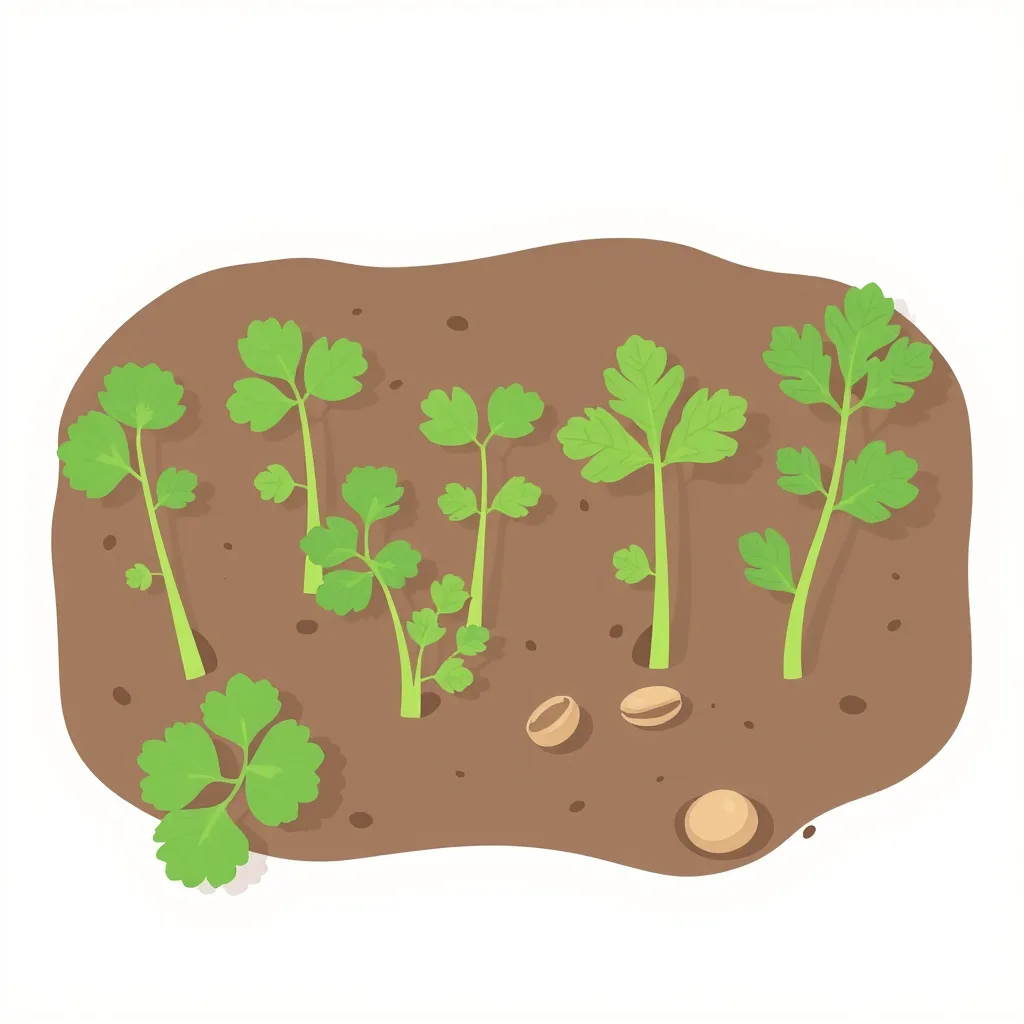
Cilantro germination time runs about 21 days, per Utah State University Extension, the day count among the four extension programs checked for this article, not the 7 to 10 days sometimes cited. None of the four, Utah State, University of Wisconsin, University of Illinois, or University of Maryland, publishes a soil temperature for germinating cilantro. What they publish instead is a pair of weather bookends: the plant bolts in heat and will not survive a hard freeze, inside this plant growth stages cluster’s germination-timing group.
That absence reframes the whole question. A sower expecting a 7 to 10 day sprout and seeing nothing by day 10 is not looking at a failed seed. Utah State’s own figure puts a normal cilantro seed at roughly three times that.
Cilantro Germination Time vs Parsley: Why One Is Faster
Utah State’s roughly 21-day figure is the one germination day count either crop has in this article’s sources. Wisconsin’s parsley page gives no matching number. It says germination may take several weeks, especially in cool, wet soil, but attaches no day count to that wait.
So the comparison the heading promises does not have two sourced day counts to work with, because only cilantro has one. What Wisconsin does give for parsley is a planting anchor rather than a sprouting speed. Seed goes into the garden once “seeds can be sown directly outdoors in spring once the soil has warmed,” or much earlier indoors, where the page tells growers to “start seeds indoors 8-10 weeks before last frost.” That eight-to-ten-week lead time measures when to sow, not how fast the seed sprouts once it is in soil, so pairing it against Utah State’s cilantro count would compare two different questions as if they were one.
This article holds to what its sources actually publish rather than filling the gap, the same standard this site’s nasturtium germination timeline applies to its own crop pairing.
Does Cilantro Seed Really Need Cracking Before Sowing?
Wisconsin’s extension program answers this question about a related herb, not about cilantro itself, and the answer is telling. Its parsley page, covering a plant in the same family, tells growers to “soak the seeds overnight to enhance germination.” Its cilantro page, from the same program, gives no equivalent step. This is not a program that stays silent on seed preparation as a subject. It has a recommendation to make, and makes it for parsley. For cilantro, it does not.
Utah State’s own figure shows what that recommendation would be fixing, if cilantro had one. Its roughly 21-day germination time is a normal wait for this seed, not a sign it needs help getting started. A grower checking the calendar against that figure has a more useful answer than one reaching for a seed-prep step this program chose not to give.
What Old Kitchen Gardeners Said About Sowing Cilantro by the Moon Phase
Older kitchen-garden habit ties cilantro sowing to the moon’s phase, part of a broader folk tradition of timing seeds to the sky rather than the thermometer.
This is tradition and cultural history, not a forecast and not advice. No extension program checked for this article ties cilantro’s sowing date to a lunar phase, and nothing here claims that timing seed to the moon changes how it germinates.
What the sourced record actually anchors cilantro’s calendar to is other plants and other seasons, not the sky. Wisconsin times spring sowing to “the same time you would plant lettuce,” a companion-crop marker rather than a date. Utah State times it to frost risk instead, “after danger of frost has passed.” Both are real, checkable signals a gardener can act on today. Neither is a lunar one, and neither program checked for this piece treats the moon as part of cilantro’s calendar at all.
If You Missed the Spring Cilantro Sowing Window
A missed spring sowing is not a lost season for cilantro. Wisconsin Extension names mid-August for a fall leaf crop specifically, a second window separate from spring. Utah State adds a regional version of the same idea: in warmer areas, “plant in the fall and harvest in the spring,” which turns a missed spring sowing into a fall one that still produces a harvest, just on the other side of the calendar.
Succession sowing extends either window. Wisconsin and Maryland both call for sowing every 2 to 3 weeks, and Illinois gives 3 to 4 weeks. Utah State frames its own version as an endpoint rather than an interval, saying successive plantings “may be done until late summer if a continued harvest is desired.” A gardener who missed the early window still has a fall option, a succession option, or both.
Two Cilantro Sowing Windows: Spring and Fall Soil Temp Ranges
No soil temperature range for either the spring or fall cilantro window turned up in the four programs checked for this article. That is the same pattern this site’s bermuda grass germination guide ran into for a different crop entirely: a real number exists somewhere on the page, but it answers a different question than the one being asked, or in cilantro’s case, it simply is not there to answer at all.
What the four programs give instead is below, built around what they actually publish rather than the soil temperature, day count, and bolting-risk countdown a tidier table would carry.
What Four Extension Programs Publish for Cilantro Sowing Timing
| Program | Sowing anchor | Succession interval | Harvest marker | What ends the crop |
|---|---|---|---|---|
| Utah State University Extension | Cooler areas: early spring, after frost. Warmer areas: fall, for a spring harvest | Until late summer (an endpoint, not a stated interval) | Leaves about 4 to 6 inches tall (a separate sentence on the same page gives 6 inches) | Not stated on this page |
| University of Wisconsin Horticulture Extension | Early spring, same time as lettuce; mid-August for a fall leaf crop | Every 2 to 3 weeks | Foliage ready in 45 to 80 days; a seed crop needs at least 100 days total | Bolts in hot weather, will not survive a hard freeze |
| University of Illinois Extension | Directly sown after danger of frost is past | Every 3 to 4 weeks | 28 to 40 days, stated for the ‘Leisure’ cultivar specifically | Short garden life with a tendency to bolt; ‘Leisure’ is described as slow to bolt |
| University of Maryland Extension | No calendar date given on this page | Every 2 to 3 weeks | Not given on this page (spacing only: thin to 7 to 10 inches apart) | Bolts in hot, humid weather |
The brief version of this table would carry a soil temperature range for each season, a days-to-germination figure, and a weeks-until-bolting countdown. Only one of those, days to germination, is sourced at all, and it comes from a single program with no seasonal split behind it. Building the other columns would mean inventing numbers no program here publishes, so the table above reports what these four programs actually say instead.
Sow, Direct Seed, or Succession Plant Cilantro
Sow, direct seed, and succession plant describe the same underlying action for cilantro, placing seed straight into the bed, repeated on a schedule. Illinois Extension calls it seed “directly sown in the garden after danger of frost is past.” Wisconsin and Maryland both set the repeat interval at 2 to 3 weeks; Illinois sets it at 3 to 4 weeks. None of the four programs checked here describes starting cilantro indoors and transplanting it, so the sourced record treats this as a direct-sown crop from the start.
When Should You Sow Cilantro for a Spring Harvest?
The answer depends on what “spring harvest” means, and Utah State’s own guidance splits on it. For a harvest that actually lands in spring, its guidance is to sow in fall, in warmer areas, and harvest in spring. Sowing in early spring instead, the timing Wisconsin ties to lettuce, produces a harvest that lands in summer or fall by Utah State’s own cooler-area line: “plant in the early spring for summer to fall harvest.” A gardener asking for a spring harvest and sowing in early spring is, by Utah State’s own framing, sowing for the wrong season.
So the sourced answer is regional. In a warmer climate, fall sowing is the route to a genuine spring harvest. In a cooler one, early spring sowing is still the right move, but it should be read as setting up a summer harvest, not a spring one.
Why Cilantro Seed Sometimes Fails to Germinate in Warm Soil
No program checked for this article publishes a germination temperature ceiling for cilantro, so no specific warm-soil threshold is reported here. What is sourced is a different, later failure: heat ends the plant’s useful life quickly once it is up and growing. Wisconsin describes cilantro as bolting in hot weather, and Maryland ties the same bolt to hot, humid conditions specifically.
That is a distinct problem from a seed that never sprouts. A seed sitting ungerminated in warm soil and a mature plant bolting in warm weather are two different points in the same season, and the sourced record here speaks clearly to only the second one. A gardener troubleshooting a bare patch of soil after sowing is working from a question these four programs do not answer, not from a documented warm-soil failure point.
Frequently Asked Questions
Does cilantro germinate faster indoors than direct-sown outside? Every sowing instruction sourced for this article describes seed placed directly into garden soil. Illinois Extension says cilantro is “directly sown in the garden after danger of frost is past,” and Utah State’s roughly 21-day figure is built on that same outdoor method. This article’s numbers are calibrated to direct sowing outdoors, not to an indoor start.
Can I soak cilantro seed before sowing to speed germination? No cilantro-specific instruction to soak or crack the seed is sourced here. Wisconsin’s extension program does publish that step, but for parsley, a related herb, not for cilantro; its own cilantro page carries no equivalent line. That contrast is covered in full above. What is sourced for cilantro itself is the day count: Utah State’s roughly 21 days, the useful number here regardless of any pre-sowing step.
Why does cilantro bolt so quickly once it warms up? Wisconsin’s extension horticulture program describes cilantro as “a cool season crop that tends to bolt (go to seed) in hot weather but will not survive a hard freeze.” Maryland Extension adds that plants “bolt (flower and go to seed) in hot, humid weather.” Between the two, heat and humidity are the named triggers; neither program gives a temperature number that marks the point.
Is coriander seed the same thing as cilantro seed for planting? Yes. The University of Wisconsin Horticulture Extension titles its page “Cilantro / Coriander, Coriandrum sativum,” naming both as the same plant. Cilantro and coriander are common names for one species, and the seed sold under either label is the same seed for sowing purposes.
Does cilantro germinate better in full sun or partial shade? The four programs checked for this article were not asked about light exposure and none volunteers a sun-versus-shade recommendation. Their guidance covers sowing dates, succession intervals, and the heat and frost limits that end the crop, not site placement.
Sources
- Utah State University Extension, Cilantro/Coriander in the Garden, the roughly 21-day germination figure, spring and fall regional sowing advice, and leaf-length harvest markers
- University of Wisconsin Horticulture Extension, Cilantro / Coriander, Coriandrum sativum, sowing anchors, succession interval, foliage and seed-crop day ranges, and the bolt-and-freeze description
- University of Wisconsin Horticulture Extension, Parsley, Petroselinum crispum, the indoor-start window, the seed-soak step, and the germination timeframe used for the parsley comparison
- University of Illinois Extension, Cilantro, the ‘Leisure’ cultivar’s day-to-harvest figure, direct-sowing instruction, and succession interval
- University of Maryland Extension, Cilantro/Coriander, succession interval, plant spacing, and the hot-and-humid bolt description
Last verified: 2026-08-17, against Utah State University Extension, University of Wisconsin Horticulture Extension (cilantro and parsley pages), University of Illinois Extension, and University of Maryland Extension.