
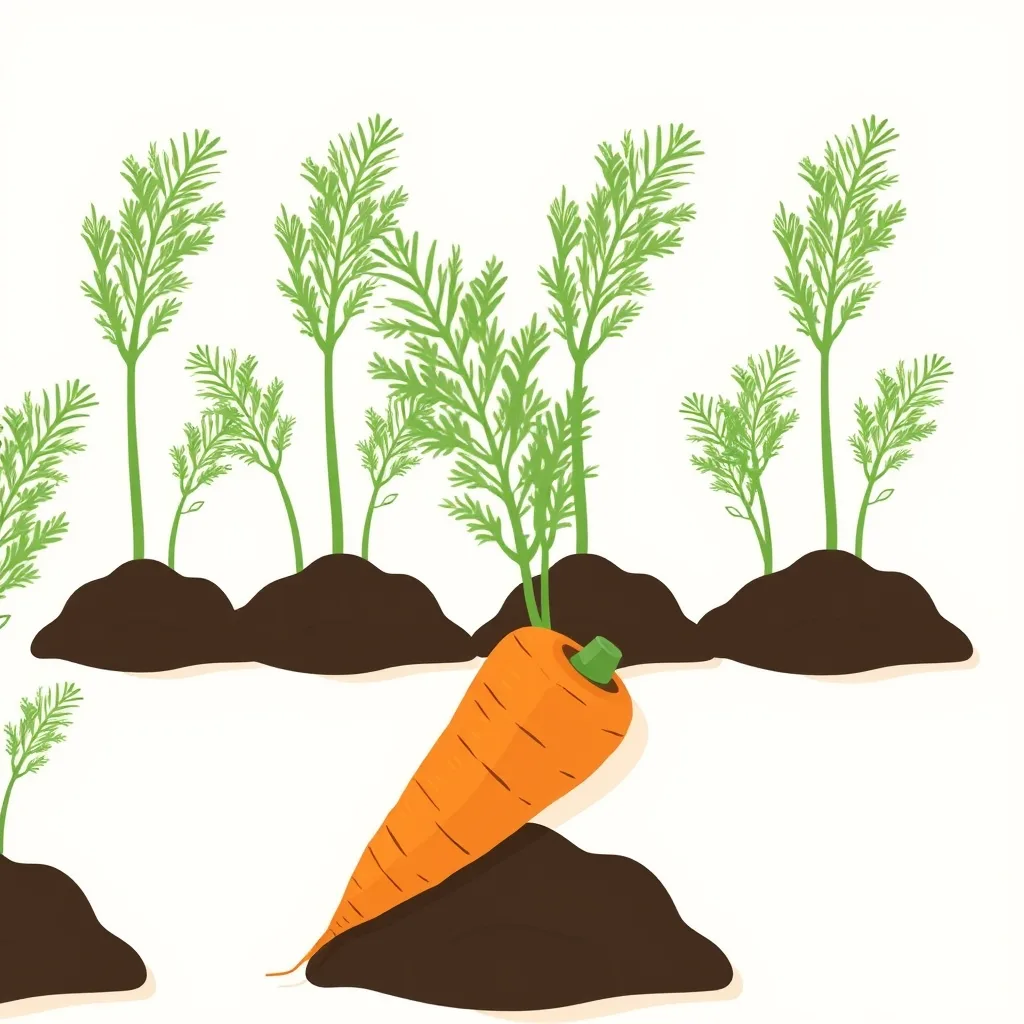
Carrot growth stages run from germination to harvest in 70 to 100 days, per Utah State University Extension, but neither Utah State nor University of Illinois Extension times a single stage by the calendar. Both gate their milestones on what the plant actually looks like: leaf count, height, or root diameter, never a day number alone. This spoke sits inside the plant growth stages hub, which sets carrot beside other root and vegetable crops on one shared timing structure.
Four stages carry a carrot from seed to harvest here: emergence, thinning, root swelling, and harvest, and the two programs disagree on how to mark at least one of them. Utah State thins by leaf count, three to four true leaves. Illinois thins by height, about one inch tall. Neither publishes a thinning date. A grower checking a calendar for carrot timing is checking the wrong instrument; the plant itself carries the schedule.
Carrot vs Radish Growth Stages: Why Carrots Take So Much Longer
Utah State runs a matching page for radish, in the same format as its carrot page, so this comparison is sourced on both sides now, not carried by carrot’s figures alone. The two crops share their start trigger exactly. Radishes can be “sown after soils reach 40ºF,” the same floor Utah State sets for carrot, and both go in “2-3 weeks before the last frost.” Radish then gets a second sowing, “in early September for fall production.” Carrot gets no fall window from Utah State at all, and is worked out by count-back below. Radish seeds germinate best “at 55-75ºF” and “require 5-10 days to emerge.” Carrot takes longer just to break the surface: 14 to 21 days, before any root growth has started.
From there the two crops pull further apart. Radish roots are “mature 25-45 days from seeding depending on variety,” while Utah State’s carrot figure is 70 to 100 days from seeding, roughly two to three times as long end for end. The succession interval follows the same ratio: Utah State sows radish “at 10 day intervals to maintain a steady supply,” against roughly four weeks between carrot sowings. Illinois backs the pattern from a second program. Its radish page gates the pull on being “of usable size” with roots “less than 1 inch in diameter,” giving no day count for radish, the same diameter rule its carrot page applies.
What stretches carrot’s run past that shared start is the slow germination above, plus a growing window that has to stay under 75°F for the plant to perform best. That is weeks spent before the carrot root even begins sizing. Radish, by contrast, reaches a mature root in 25 to 45 days from seeding, its entire run seed to harvest.
Does Carrot Foliage Height Really Tell You Root Size?
No. Neither Utah State nor Illinois publishes a relationship between the height of a carrot top and the size of the root underneath it. What both programs measure instead is the root directly. Illinois sets three thresholds by diameter: pull at a minimum of 1/2 inch, expect standard varieties to reach 3/4 inch around 60 to 70 days after planting, and treat 1 to 1 1/2 inches as over mature.
A tall, leafy top can belong to a carrot with a thin root still weeks from that 3/4 inch mark, and a modest top can sit over a root already past it. Foliage tells a grower the plant is alive and photosynthesizing. It does not report what is happening below the soil line. The reliable check is the one Illinois publishes: feel for the shoulder of the root itself.
What Old Gardeners Watched For Before Pulling a Test Carrot
Before diameter charts were a standard garden tool, the practice was simpler. Brush soil back from the top of one root in the row and judge its shoulder width by eye, before deciding whether to pull the rest of the bed.
This is tradition and cultural history, not a measurement and not a planting rule. An eye check cannot match a ruler against Illinois’ own 1/2 inch, 3/4 inch, and 1 to 1 1/2 inch thresholds, and this site does not claim it once could.
The habit survives because it was doing, roughly, what Illinois’ published diameter thresholds now do with a number attached: checking the root itself rather than trusting the leafy top or a date on the calendar. A test carrot pulled and examined today answers the same question Illinois’ chart answers, just without the ruler.
If Your Carrots Are Behind Schedule by Late Summer
Utah State’s own maturity window already spans 70 to 100 days, a 30-day range that makes “on schedule” a loose target to begin with. A planting still small in late summer may simply sit at the slower end of that range rather than behind it.
The sourced ceiling to watch for is Illinois’ over-mature mark, 1 to 1 1/2 inches in diameter. Roots past that point have outgrown the standard harvest window Illinois describes, whatever the calendar says. Checking a root’s actual diameter against that figure, rather than counting weeks against an assumed planting date, is the sourced way to tell whether a late-summer bed is genuinely behind or just running toward the long end of Utah State’s range.
Carrot Growth Stage Timing by USDA Zone and Sowing Date
Zone numbers cannot answer this one. The 2023 USDA map sorts places by how cold their winters get, while carrot timing turns on how fast the ground warms in spring, a different question about a different season. Two towns sharing a zone can hit Utah State’s 40°F sowing floor weeks apart, and elevation is usually why.
What the sources actually key their timing to is temperature and the reader’s own frost dates. Utah State’s thresholds run like this. Sow once soil reaches 40°F. Germination runs best at 55 to 65°F, and in Utah State’s words, “Temperatures above 80°F reduce seed germination.” Growth stays healthiest under 75°F. Spring sowing goes in two to three weeks before the local last frost, repeated every four weeks through midsummer.
Utah State publishes no fall sowing window, and none is invented here. For a fall carrot the sourced procedure is a count-back. Take the 70 to 100 days to maturity, add the 14-day fall factor from University of Nebraska-Lincoln Extension’s G1343, and count back from your own first fall frost. That puts a fall sowing target roughly 84 to 114 days ahead of frost, a range built from these two sources rather than one either publishes directly. A last-frost or first-frost date for a specific location is worked through on the planting calendar hub, sourced to NOAA and NWS station normals rather than a zone number.
4 Carrot Growth Stages From Seed to Root Maturity
Between them, Utah State and Illinois publish both an above-ground and a below-ground marker for most of a carrot’s run, which is unusual for a root crop and lets this table carry more than most. The four stage names below are this site’s own organizing frame; neither program publishes a numbered carrot stage taxonomy, so the anchors are sourced and the four-part shape is not.
4-Stage Carrot Growth Timeline, Utah State and Illinois Extension Sourced Anchors
| Stage | Stage name | Days since sowing | Above-ground sign | Below-ground sign | Grower action that week |
|---|---|---|---|---|---|
| 1 | Emergence | 14 to 21 days (Utah State); “as long as two weeks” (Illinois) | Seedlings break the surface, unevenly | None published | Watch and wait; thinning is gated on leaf count or height, not a day number, so none yet |
| 2 | Thinning | None published by either program | 3 to 4 true leaves (Utah State) or about one inch tall (Illinois) | None published | Thin to reduce crowding, by leaf count or by height depending on which program’s marker is used |
| 3 | Root swelling | About 40 to 50 days (Illinois) | None published | Roots swelling | Pull loose soil up against the row to prevent sunburn on the swelling shoulders (Illinois) |
| 4 | Harvest | 50 to 60 days for finger carrots; about 60 to 70 days to 3/4 inch; 70 to 100 days to Utah State’s full maturity | None published | At least 1/2 inch diameter to pull; over mature at 1 to 1 1/2 inches | Check root diameter directly against Illinois’ thresholds before pulling |
Stage 2 carries no published day count from either program, which is the clearest evidence that thinning is not a calendar event here. Stage 4 carries two day figures because the two programs stop counting at different moments, Illinois at a 3/4 inch root and Utah State at a finished one. Read either against its own endpoint and both are usable; collapse them into a single number and the endpoint is what gets lost.
When Should You Expect Carrot Seedlings to Break the Soil Surface?
Utah State puts carrot germination at 14 to 21 days once soil holds the 40°F sowing floor. Illinois gives a looser figure, “as long as two weeks,” and adds that the seedlings “may not emerge uniformly.” Both describe a slow, uneven start compared with faster garden seeds. Carrot is not alone in its own family on this: Utah State puts cilantro at about 21 days, which is the same unhurried pattern in another umbellifer.
Temperature moves that window directly. Utah State’s germination optimum is 55 to 65°F, and germination above 80°F is reduced by its own account. A bed sown right at the 40°F floor will likely sit at the slow end of the 14 to 21 day range. One sown once soil has warmed into the 55 to 65°F band should emerge closer to the fast end, though neither program breaks the range down by exact soil temperature.
Why Carrot Growth Stages Sometimes Stall at the Seedling Phase
Both programs address all three causes usually named here. Utah State is blunt about crusting: “Crusting soils will limit seedling emergence and affect plant stands.” It says carrots “do not compete well with weeds” and puts that pressure early, during germination and establishment. Crowding is the one answered with an instruction instead of a warning, thinning at 3 to 4 true leaves for Utah State and about one inch tall for Illinois.
Two of those pull against each other. “Dense plantings will reduce weed pressure,” Utah State says, so a thick stand helps on weeds and hurts on crowding at once. Thinning resolves it, and it is a marker rather than a date because the plant decides when.
What is sourced is what crowding does: seedlings left unthinned past either program’s marker compete for the same root space a swelling carrot needs later. That is why thinning sits in the table above as its own stage rather than an incidental task, even though it carries no day count of its own.
Carrot Growth Stage Calendar for Spring and Fall Sowing
Spring sowing anchors to the local last frost. Utah State sows two to three weeks ahead of it, once soil has reached the 40°F floor, and repeats every four weeks through midsummer for season-long production, each new sowing running its own 70 to 100 day clock behind the last.
Utah State publishes no fall sowing window, so the fall side of this calendar is a count-back rather than a fixed date. Using the 70 to 100 day maturity figure plus the 14-day fall factor from University of Nebraska-Lincoln Extension’s G1343, a fall carrot needs roughly 84 to 114 days between sowing and the reader’s own first fall frost. That is this site’s own arithmetic, combining two sources that do not publish it together, not a figure either program states outright. A reader’s own frost dates by state are worked through on the planting calendar hub linked above.
Count Days Since Thinning, Not Since Sowing, for Root Sizing
That does not fix the problem it is meant to solve, because thinning has no date of its own either. Utah State marks it by leaf count, three to four true leaves. Illinois marks it by height, about one inch tall. Neither ties either marker to a day number, so counting forward from “the day I thinned” still starts from a moving target that arrives on the plant’s own schedule, not the sower’s.
What is actually checkable, and needs no start day at all, is root diameter. Illinois publishes three thresholds you can check against the root itself: 1/2 inch to pull, about 3/4 inch for standard varieties at 60 to 70 days, and 1 to 1 1/2 inches as over mature. No clock runs behind any of them. A grower who wants a reliable sizing check is better served pulling one test root and reading its diameter than counting days from an event that was never dated in the first place.
Frequently Asked Questions
Do all carrot varieties move through growth stages at the same speed? No, and Illinois Extension splits them itself. It puts the finger types at the 50 to 60 day mark and holds everything else back to a 3/4 inch root, which it places about ten days later at either end of the range. One program, one page, two answers, because the second one is waiting on a size rather than on a date.
Can carrot growth stages be sped up with extra watering? No source checked for this article publishes a watering-based acceleration figure for carrot growth stages. What Utah State and Illinois do publish is temperature-gated timing: soil at 40°F to sow, 55 to 65°F for the fastest germination, and growth staying healthiest under 75°F. Watering is not the lever either program ties to stage speed.
Why do carrots in containers sometimes show different stage timing? Utah State’s and Illinois’ soil-temperature thresholds, the 40°F sowing floor and the 55 to 65°F germination optimum, are the sourced figures that apply regardless of container or ground. A container’s soil generally tracks air temperature faster than an in-ground bed does, which is the likely source of any timing difference a grower notices.
Does soil type change how long each carrot growth stage lasts? Neither program publishes a duration figure by soil type. What Illinois does address is soil condition during root swelling: pulling loose soil up against the row once roots begin swelling, about 40 to 50 days after planting, to prevent sunburn on the exposed shoulder. That is a soil-handling step tied to one stage, not a claim that soil type changes how long any stage runs.
Sources
- Utah State University Extension, How to Grow Carrots in Your Garden: soil temperature thresholds, germination window, days to maturity, spring sowing lead time, succession interval, thinning marker.
- University of Illinois Extension, Carrots: germination uniformity, harvest diameter thresholds, thinning marker and density, hilling timing against sunburn.
- Utah State University Extension, How to Grow Radishes in Your Garden: radish sowing and germination temperature thresholds, days to emergence, days to maturity, spring and fall sowing timing, succession interval.
- University of Illinois Extension, Radish: radish harvest size threshold, used in the carrot vs radish comparison above.
- University of Nebraska-Lincoln Extension, G1343: the 14-day fall factor used in the fall count-back procedure.
- The carrot’s stage timeline draws on the same root-crop framing worked through for potato growth stages, pumpkin growth stages, and green bean plant stages.
Last verified: 2026-08-17, against Utah State Extension’s carrot and radish guides, Illinois Extension’s carrot and radish pages, and UNL Extension G1343.