
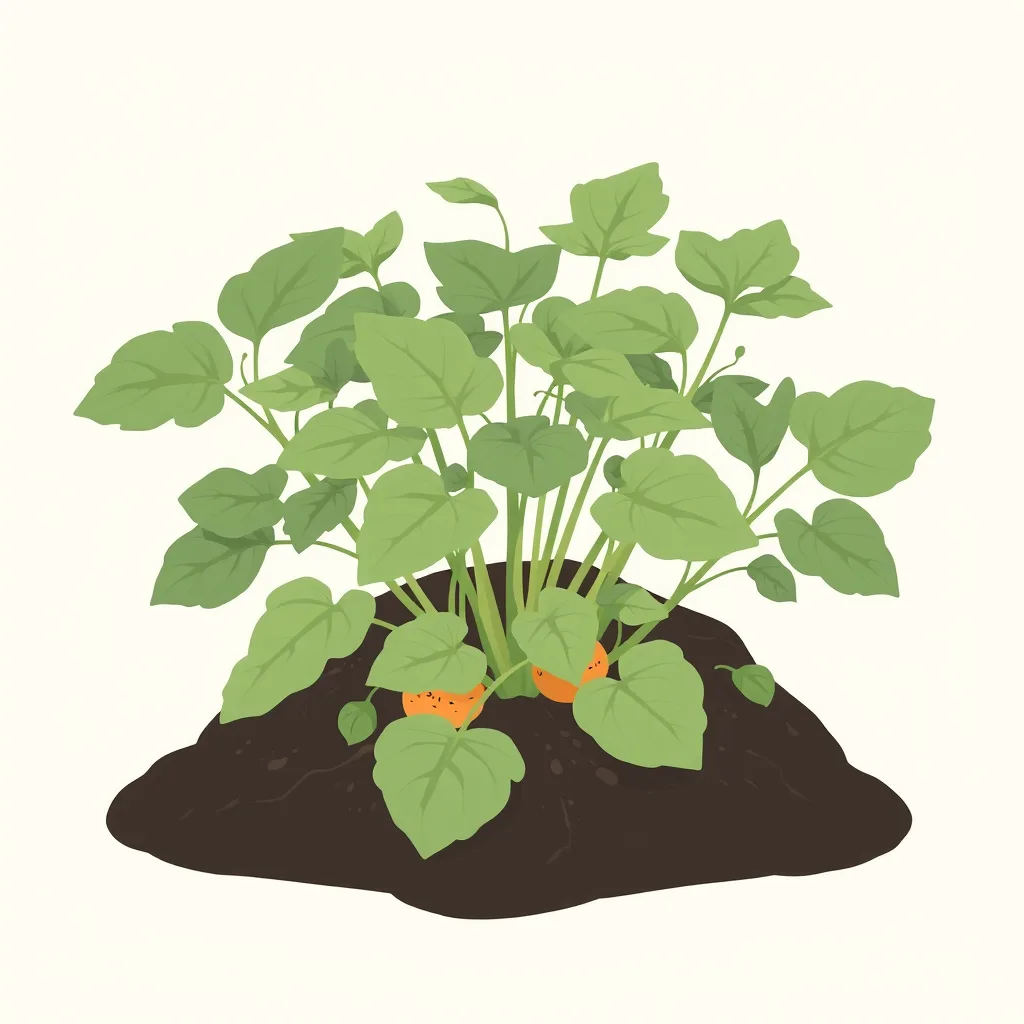
Potato growth stages begin once soil reaches at least 50°F at planting depth, the threshold Utah State University Extension gives for planting. Sprouts emerge in ten to fourteen days according to University of Florida IFAS, and the full run to harvest spans 80 to 115 days by UF/IFAS’s count or 100 to 120 days by Clemson HGIC’s, roughly 11 to 17 weeks depending on the program’s climate and cultivars. This spoke sits inside the plant growth stages hub, alongside root and legume crops on one shared timing structure. Five named stages carry a potato plant from sprout to harvest: sprout development, vegetative growth, tuber initiation, tuber bulking, and maturation. UF/IFAS’s bulletin HS183 publishes a day range for four of the five, 0-30, 30-55, 55-70, and 60-120 days; only maturation carries none, and the ranges overlap rather than sum to a stage-by-stage calendar.
How Long Do Potato Growth Stages Take From Sprout to Harvest?
University of Florida IFAS puts the full potato cycle at 80 to 115 days after planting, while Clemson HGIC puts it at 100 to 120 days to maturity. Both are Tier-1 extension programs, not competing predictions to average together: UF/IFAS describes Florida’s growing conditions, Clemson South Carolina’s.
Inside either span, growth moves through five named stages, laid out with their above-ground and below-ground signs in the table below. UF/IFAS’s technical bulletin HS183 publishes a day range for four of them: sprout development 0-30, vegetative growth 30-55, tuber initiation 55-70, and tuber bulking 60-120 days. Stage three and stage four overlap by ten days, and stage four’s own upper bound runs past the 80 to 115 day harvest window above; HS183 gives no range for the fifth stage, maturation.
What Happens If You Plant Seed Potatoes Too Early in Cold Soil
Utah State University Extension sets the planting threshold at soil “at least 50°F,” and plants 14 to 21 days before the last frost date, a window it also phrases as two to three weeks before. Neither UF/IFAS nor Clemson publishes a rot temperature or a below-45°F failure point for potato; the sourced guidance is the 50°F minimum itself, not a separate lower danger line.
What is sourced, and bears on cold, wet soil, is seed-piece handling. Clemson HGIC has growers cut seed pieces three to five days before planting so the cut surface heals before it goes into the ground. A cut surface that has not healed, set into soil below 50°F, goes into the ground at its most vulnerable and slowest-warming point at once. Below that threshold, UF/IFAS’s emergence window has not started counting, which reads from above ground as nothing happening rather than as a plant already in trouble.
5 Potato Growth Stages, Sprout to Tuber Bulking, Week by Week
UF/IFAS’s Growing Potatoes in Florida names and defines all five stages. The table below carries each stage’s above-ground sign, its below-ground activity, and the day anchor UF/IFAS publishes for it, where one exists.
5-Stage Potato Growth Timeline, UF/IFAS Sourced Day Ranges
| Stage | Stage name | What you can see above ground | What is happening below ground | Sourced day anchor |
|---|---|---|---|---|
| 1 | Sprout development | Sprouts push up through the soil surface | Eyes on the seed piece develop sprouts | “Ten to fourteen days after planting” (UF/IFAS) |
| 2 | Vegetative growth | Leaves and stems form and expand | Roots develop and the plant begins directing nutrients toward future tubers | “30-55 days” (UF/IFAS HS183) |
| 3 | Tuber initiation | Foliage still reads as ordinary vegetative growth | Tubers begin forming at the ends of underground stolons, usually before the plant flowers (UF/IFAS) | “55-70 days” (UF/IFAS HS183) |
| 4 | Tuber bulking | Vine at or near full size | Tubers enlarge as sugars and starches accumulate | “60-120 days, depending on variety” (UF/IFAS HS183) |
| 5 | Maturation | Foliage yellows, then dries and dies back | Tubers reach full size | No range published (UF/IFAS HS183) |
| Whole cycle | Planting to harvest | (spans all five stages) | (spans all five stages) | “80 - 115 days” (UF/IFAS) or “100 to 120 days” (Clemson HGIC) |
HS183’s day ranges are Florida figures that do not stack into a tidy sequence. Tuber initiation (55-70 days) and tuber bulking (60-120 days) overlap by ten days, because bulking is underway on some stolons before initiation finishes on others, and bulking’s upper bound, 120 days, runs past the top of UF/IFAS’s 80 to 115 day harvest window. Each range is its own stage window, not a segment that sums to a total. Competitors tend to fix that untidiness rather than report it: theseasonalhomestead.com publishes 30 to 60 and 50 to 70 days for the same stages HS183 lists as 30-55 and 55-70, and adds an 80-to-120-day maturation range HS183 never gives. Reporting HS183 as published, overlaps included, is the more accurate page. Clemson’s 100-to-120-day figure is a separate South Carolina number, not confirmation of Florida’s ranges.
What ‘Tuber Initiation’ and ‘Tuber Bulking’ Actually Mean
Tuber initiation, UF/IFAS’s stage three, is the point where “tubers begin forming on the end of stolons (underground stems), usually before the plant flowers.” In plain terms, the plant starts building the tubers themselves, entirely below the soil line while the vine above still looks like ordinary vegetative growth. Tuber bulking, stage four, is what follows: “tubers enlarge. sugars and starches accumulate.” The vine can look the same from outside across both stages; the real difference is tuber size, not visible without digging.
Hilling connects to both. Utah State Extension calls for hilling “within four weeks of planting,” mounding soil over the developing stolons and keeping light off the forming tubers as initiation gets underway. A row that misses its hilling window can still initiate tubers, but they sit closer to the surface and the light, a management difference rather than a stage difference.
How Many Weeks Between Flowering and Tuber Bulking in Potatoes?
Neither UF/IFAS nor Clemson gives a flowering-to-bulking week count, and there is a specific reason: flowering is not the event the tuber timeline runs on. UF/IFAS’s own stage-three definition places tuber initiation before flowering, tubers begin forming “usually before the plant flowers.” Counting weeks forward from a bloom that may already be behind the tuber-formation clock is not a framework either UF/IFAS or Clemson HGIC publishes.
What both programs anchor to instead is tuber size and, later, foliage condition. If a bulking length matters for planning, the sourced anchor is the whole-cycle span given above, not a sub-interval measured from bloom. The carrot’s own stage timeline works through a similar root-crop case where the harvested part forms out of sight below ground.
Early Season vs Late Season Potato Varieties: How the Stage Timeline Shifts
The two totals cited throughout this article are the closest sourced approximation of an early-versus-late spread. Neither program labels its figure “early variety” or “late variety”; each describes its own state’s growing conditions and commonly planted cultivars. A four-column table with separate day counts for days to flowering, days to bulking start, and days to foliage die-back, broken out by variety type, is not supported by any source checked here, so this article does not build one.
Potato Harvest Range, UF/IFAS vs. Clemson HGIC
| Comparison | Total days, planting to harvest | Source |
|---|---|---|
| UF/IFAS range (Florida growing conditions) | 80 to 115 days | UF/IFAS, Growing Potatoes in Florida |
| Clemson HGIC range (South Carolina growing conditions) | 100 to 120 days | Clemson HGIC, Potato |
The 20-day gap at the low end and 5-day gap at the high end most likely reflects cultivar choice and regional climate rather than an early-versus-late split, but neither source states that explicitly, so this article does not either.
Do Potato Plants Really Need to Flower Before Tubers Form?
No. UF/IFAS answers this directly inside its stage-three definition: tuber initiation happens on the ends of underground stolons “usually before the plant flowers.” Flowering is not a precondition for tuber formation in the source checked here; it reads as a coincidence of timing rather than a trigger.
This corrects a version of the potato rule that circulates widely, that a gardener should wait for bloom before expecting tubers, or count forward from bloom to estimate harvest. UF/IFAS’s own wording removes flowering as the reference point. A plant that has not yet bloomed is not necessarily behind; one already carrying small tubers before its first flower opens is, per this source, the typical order.
Why Potato Growth Stages Sometimes Stall at the Vegetative Phase
Utah State does publish a heat figure, but not a vegetative-stage one: its potato page ties tuber problems to soils above 90°F and says tuber set and fill is inhibited by high temperatures, a figure covering stages three and four, not the leafy vegetative stage here. No fertilizer or watering figure that stalls vegetative growth is published by UF/IFAS, Clemson, or Utah State. What UF/IFAS does publish is what this stage is doing: the plant builds “the leaves, stems, and root system,” starts photosynthesis, and prepares to direct nutrients toward tubers, before tuber initiation begins.
Because initiation does not wait for flowering, as established above, a plant that still looks purely vegetative from above may already be initiating tubers below the hill line. What reads as stalling is sometimes the plant moving into stage three out of sight. The management window tied to this stretch is Utah State’s hilling call, within four weeks of planting; a bed still unhilled well past that point is a scheduling gap worth closing, even though neither source ties a missed hilling date to a stalled-day count.
If Your Potato Plants Are Behind Schedule by Midsummer
The two whole-cycle totals cited throughout this article already disagree by as much as 40 days at their widest points, the clearest argument for not treating a fixed calendar date as the trigger. Clemson HGIC’s actual harvest signal is foliage-based: main harvest comes “about two weeks after the vines die down in midsummer,” a condition UF/IFAS describes the same way in its stage-five definition, “the top of the plant dries out and dies.”
A planting that looks behind a generic midsummer expectation may simply belong to the slower end of either program’s range, or to a cultivar and climate closer to Clemson’s figures than UF/IFAS’s. Watching for die-back is the sourced substitute for watching a date. The green bean’s own stage timeline covers a legume that reaches harvest on a similarly foliage-cued schedule.
Potato Stage Timing Shifts by USDA Zone and Planting Date
A USDA hardiness zone number describes average winter minimum temperature, not spring soil warm-up speed or a frost date, so it does not answer when a stage should arrive. Two towns in the same zone can warm to Utah State’s 50°F soil threshold weeks apart, depending on elevation, soil type, and local weather the zone map does not track. The sourced triggers that move with the actual calendar are Utah State’s own: soil “at least 50°F” at planting depth, and planting 14 to 21 days before the local last-frost date, both conditions a grower can check directly rather than infer from a zone number.
Clemson HGIC gives one legitimate regional worked example, keyed to South Carolina’s own named regions rather than a national zone map: Coastal planting runs “Feb 1 - Mar 31,” Piedmont planting runs “Mar 15 - Apr 30,” a six-week difference within one state. That is the scale of variation a zone number cannot capture. For a last-frost date and a state-by-state planting window outside South Carolina, the planting calendar hub works from NOAA and NWS station data rather than a zone number alone.
Signs a Potato Crop Is Ready to Dig, Pull, or Harvest
Foliage is the sourced signal, not a date on the calendar. UF/IFAS’s stage-five definition states that maturation is reached once “the tubers reach full size” and “the top of the plant dries out and dies.” Both programs then time harvest from that same event: UF/IFAS’s own SFYL page gives “approximately two to three weeks after the plant has died,” and Clemson HGIC gives “about two weeks after the vines die down in midsummer.”
Before that point, Clemson notes that some growers dig a first, smaller round of tubers while the vines are still green, once the tubers below have reached the size the grower is targeting, rather than waiting for full die-back. That earlier dig depends on checking tuber size directly, by hand, rather than reading a sign above ground. This article stops at the digging itself, foliage color and die-back as the readiness signal.
Frequently Asked Questions
How many potato growth stages are there in total? Five, by UF/IFAS’s count in Growing Potatoes in Florida: sprout development, vegetative growth, tuber initiation, tuber bulking, and maturation. HS183, UF/IFAS’s technical bulletin, gives a day range for the first four, 0-30, 30-55, 55-70, and 60-120 days; only maturation carries none.
Does potato foliage dying back always mean the crop is ready? Foliage die-back is UF/IFAS’s own maturation signal, “the top of the plant dries out and dies,” and both programs time harvest from it: UF/IFAS gives approximately two to three weeks after the plant has died, Clemson about two weeks after the vines die down in midsummer. Clemson also describes growers digging an earlier, smaller round of tubers before full die-back, based on tuber size rather than foliage condition, so die-back marks the main harvest window, not the only point tubers exist below ground.
Can potato growth stages overlap between plants in the same bed? UF/IFAS’s own emergence window spans four days, ten to fourteen days after planting, for plants set at the same time. Seed-piece size, planting depth, and soil temperature can widen that further across one bed, so plants in one row often show different visible stages at once. UF/IFAS and Clemson give no bed-level synchrony figure beyond that emergence window.
What causes uneven potato growth stages across one row? The sourced factors are planting depth, soil temperature, and seed-piece condition. Utah State Extension’s 50°F soil threshold is measured at planting depth, which can vary within one row if the row was not dug to a consistent depth. Clemson HGIC’s seed-piece cutting window, three to five days before planting, exists so cut surfaces heal before going into the ground; a piece planted before its cut has healed starts from a different condition than one given the full window. Neither source quantifies how many days of spread each factor adds.
Sources
- UF/IFAS, Growing Potatoes in Florida: the five named growth stages, emergence timing, whole-cycle harvest range.
- UF/IFAS EDIS HS933/HS183, Growing Potatoes in the Florida Home Garden, reviewed 19 Feb 2025: per-stage day ranges for four of the five stages.
- Clemson HGIC, Potato: days to maturity, main harvest timing, seed-piece cutting window, South Carolina regional planting windows.
- Utah State University Extension, Potatoes in the Garden: soil temperature threshold, planting window, hilling timing, tuber set and fill heat figure.
Last verified: 2026-08-17, against the UF/IFAS Growing Potatoes in Florida, UF/IFAS EDIS HS183, Clemson HGIC Potato, and Utah State University Extension Potatoes in the Garden pages cited above.