
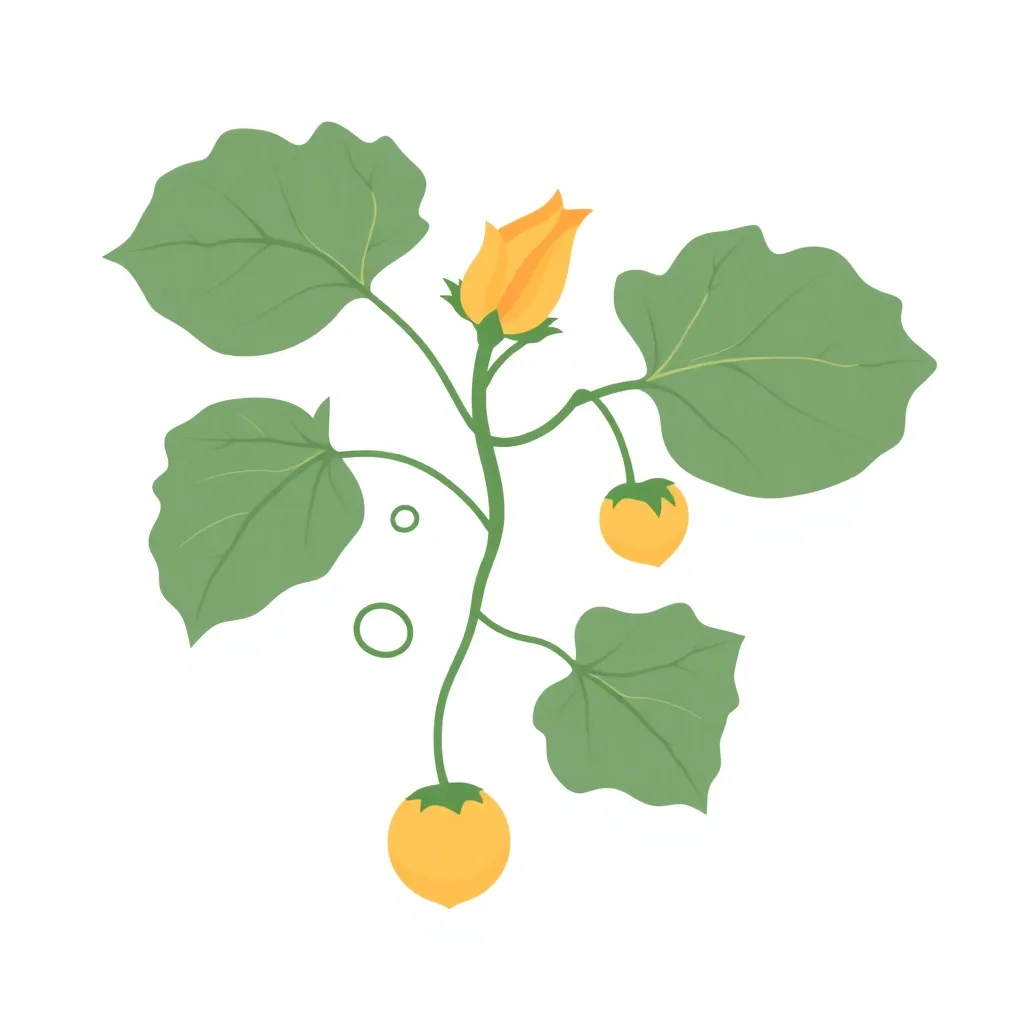
Six named stages carry a pumpkin from seed to harvest: germination, early vine growth, flowering, fruit set, fruit sizing, and ripening. Only one of them carries a published duration of its own: University of Maryland Extension puts germination at “7 to 10 days”, fast against many seeds but slow against rye grass. The rest are covered only by spans. Utah State Extension gives 45 to 55 days from flowering to mature fruit, the last three stages together, inside a total season University of Georgia (UGA) Extension Bulletin 1180 puts at 80 to 130 days. The four stages in between are described here by what a grower can see, because no source checked for this article times them individually. This spoke sits inside the plant growth stages hub, which sets pumpkin beside tomato and field corn using a general vegetable framework whose stage names differ from the pumpkin-specific six used here.
If Your Pumpkin Vine Seems Stuck at One Stage, Start Here
A vine held at one visual stage for two or three weeks is usually waiting on a measurable condition rather than failing:
- Soil temperature. Utah State Extension plants once “soils are 65°F,” while UGA B1180 says to “delay planting until the soil has warmed to 70-80°F,” five to fifteen degrees apart on the same decision. Neither is wrong; they are two extension programs setting different thresholds. A seed below whichever threshold applies has not started its clock yet, which reads as “stuck” but is really “not yet begun.”
- Cold, wet soil. UGA notes that “pumpkin and gourd seed may decay if planted into cold, wet soil,” a separate risk from simply being slow.
- Air temperature during germination. UGA states “the mean air temperature is 65-75°F for good germination.” Outside that range, germination can drag on.
- Crowding before thinning. Utah State thins “after they have two leaves, thin to two plants per mound,” while CSU PlantTalk 1807 thins “when the plants have three or four leaves, thin to one plant every two feet.” Different leaf counts and densities, reported as published rather than reconciled.
- Row covers left on too long. Utah State removes covers “when plants start to flower or when temperatures exceed 90°F.” A vine still covered past that point can look stalled.
Pumpkin Growth Stages by Region: Short-Season vs Long-Season Areas
No source checked for this article publishes a region-by-region table of days per pumpkin growth stage. What drives whether a region can ripen pumpkin at all is UGA’s season length set against how many frost-free days a location has. NOAA-normal growing-season counts, by state anchor station, make that concrete:
Pumpkin Season Fit by Region
| Region example | Station (NOAA normals) | Frost-free growing days | UGA pumpkin season need | Fit |
|---|---|---|---|---|
| Short-season | Bismarck, North Dakota | 136 days | 80 to 130 days | Tight but workable. Even UGA’s slowest listed variety, Atlantic Giant at 115 to 125 days, fits inside 136 frost-free days, but by as little as 11 days, so a late spring or an early frost erases the buffer. |
| Mid-season | Columbus, Ohio | 192 days | 80 to 130 days | Comfortable margin for most listed varieties. |
| Long-season | Atlanta, Georgia | 250 days | 80 to 130 days | Full margin, including Atlantic Giant at 115 to 125 days. |
That comparison pairs NOAA frost-date normals with UGA’s variety table; neither publishes it combined. A short-season location has less room for error, so a stalled week costs more in North Dakota than in Georgia.
Sprout, Vine, or Set Fruit: Naming Each Pumpkin Growth Stage
Gardeners use several overlapping words for the same early stages, so fixing the vocabulary first helps. This article uses six pumpkin-specific stage names. They are deliberately not the same six as the general vegetable framework on this site’s hub, which runs germination, seedling, vegetative, flowering, fruit set and maturity; stage names and counts vary by crop and by source, which the hub works through in its own right.
- Germination (“sprouting”): seed takes up water and pushes a root down, no leaf visible yet.
- Early vine growth: true leaves unfold, plant begins running, no flowers yet.
- Flowering: the vine opens its first flowers.
- Fruit set: a flower is followed by a small fruit that holds and begins to enlarge, rather than dropping.
- Fruit sizing: the fruit expands, still soft-skinned, typically green or pale.
- Ripening: the fruit reaches full size and the rind hardens toward its mature color.
“Vine” gets used loosely for both the whole plant and the early vegetative stage. “Set fruit” sometimes means the whole fruiting process and sometimes stage 4 alone; this article keeps the narrow sense.
When Should You Expect Pumpkin Vines to Start Flowering
No source checked for this article publishes a days-from-planting-to-first-flower figure for pumpkin. What is published brackets it indirectly. UGA puts the whole season at 80 to 130 days, and Utah State puts the final flowering-to-maturity stretch at 45 to 55 days. Subtracting those, a calculation this article performs and neither source states, leaves roughly 25 to 85 days between planting and flowering. That is a wide bracket, not a date; the stage-duration section below explains why it comes out so wide.
The reliable signal instead is soil temperature: a vine planted once soil reaches Utah State’s 65°F or UGA’s 70-80°F threshold, under UGA’s 65-75°F germination air temperature, is on the clock. Cooler soil starts that clock later, and none of the sources checked here says by how much.
Why Some Pumpkin Vines Flower but Never Set Fruit
A vine can open flowers and still show no small fruit forming for a stretch, and the flowers themselves usually explain it. Illinois Extension states the order plainly: “The first flowers are almost always male. The pollen on these first male flowers attracts bees and alerts them to the location of the blooming vines. By the time the first female blossoms open, the bees’ route is well established.” Fruit follows a female flower, so a vine carrying only male blooms has not reached the point where fruit set is possible.
University of Maryland Extension puts a length on that run: “Similar to other members of the squash family, pumpkins produce male flowers for 1 to 2 weeks before female flowers appear.” So a fortnight of flowers without fruit is the documented normal, not a fault. It also means a flowering vine has already started Utah State’s 45-to-55-day clock, which runs from flowering rather than from fruit set. Early vine growth, flowering without fruit, and fruit sizing all look similar from a distance, and none of the three is a stall.
Pumpkin Growth Stages Month by Month, May Through October
Pumpkin planting and bloom timing anchor to a handful of sourced calendar points, not one national schedule. The table below builds a month-by-month picture from those anchors; state-specific figures are labeled as such.
Pumpkin Growth Stages Month by Month
| Month | What the sources anchor | Source |
|---|---|---|
| May | Colorado planting: “plant pumpkins in late May” (Colorado-specific) | CSU PlantTalk 1807 |
| May-June | Earliest national planting, “two weeks before the last frost,” only with plastic mulch and row covers | Utah State Extension |
| June-July | Early vine growth once soil and air thresholds are met; no day count published for this stage | UGA B1180; Utah State Extension |
| Late July-early August | Bloom and fruit period, Colorado-specific: “keep plants watered between late July and early August when they bloom and fruit” | CSU PlantTalk 1807 |
| August-September | Fruit sizing after fruit set; row covers, where used, come off “when plants start to flower or when temperatures exceed 90°F” | Utah State Extension |
| September-October | Ripening toward harvest signs, within the 80-to-130-day total season | UGA B1180 |
The Colorado rows describe Colorado’s calendar specifically, not a national schedule; a warmer or longer-season state can plant earlier and bloom sooner within UGA’s broader 80-to-130-day frame.
Count Days to Pumpkin Maturity Backward From Your Target Harvest Date
The one interval with a published duration, flowering to maturity, is the most useful one for counting backward from a target date. Utah State’s 45 to 55 days from first flower to mature fruit means a grower who wants pumpkins ready by a specific week can count back 45 to 55 days and treat the result as roughly when flowering needs to begin, not when the seed goes in the ground.
Counting backward from planting is far less precise: the arithmetic above brackets the pre-flowering stretch at roughly 25 to 85 days, too wide to plan from. Garlic’s fall planting window counts backward from a fixed point for the same reason.
How Long Does Each of the Six Pumpkin Growth Stages Last
Here is the honest accounting, stage by stage, against the sources checked for this article: UGA Bulletin 1180, Utah State Extension’s Pumpkins in the Garden, CSU PlantTalk 1807, University of Maryland Extension and Illinois Extension.
Pumpkin Growth Stage Duration, Stage by Stage
| Stage | What you can see | Published timing | Source |
|---|---|---|---|
| 1. Germination | Root emerges, no leaf visible yet | “Expect germination in 7 to 10 days” | University of Maryland Extension |
| 2. Early vine growth | True leaves unfold, vine begins running | Not individually published | none checked |
| 3. Flowering | First flowers open | Not individually published | none checked |
| 4. Fruit set | Small fruit holds and begins to enlarge | Not individually published | none checked |
| 5. Fruit sizing | Fruit expands, skin still soft | Not individually published | none checked |
| 6. Ripening | Fruit reaches full size, rind hardens toward mature color | Not individually published | none checked |
| Stages 4 to 6 together | First flower through mature fruit | 45 to 55 days | Utah State Extension |
| Stages 1 to 6 together | Planting through harvest | 80 to 130 days | UGA B1180 |
Only the first of the six stages carries a duration of its own: University of Maryland Extension gives “Expect germination in 7 to 10 days”. Everything after that is published as a span rather than a stage, and UGA’s bulletin carries two spans that do not match each other.
Its Climatic Requirements section says pumpkins and gourds “require a sunny environment as well as a long growing season of 80 to 130 days.” Its Harvesting section says “Pumpkins and gourds are harvested at full maturity. This means a growing season of 90 to 120 days will be required.” Same bulletin, two answers, fifty days apart at the outer edges, and no source checked here explains the difference. Its own Table 1 runs from Munchkin at 85 to 100 days up to Atlantic Giant at 115 to 125, which fits the wider figure but overruns the narrower one at both ends. Maryland adds a third: “Most pumpkins require more than 100 days to ripen.”
That matters for the subtraction. Taking Utah State’s 45 to 55 days off UGA’s wider 80-to-130 figure brackets germination through flowering at roughly 25 to 85 days; taking it off the narrower 90-to-120 figure gives roughly 35 to 75. Either way it is a wide band and the arithmetic is this article’s own, not a figure any source states. It is wide enough to explain why a vine can look “on schedule” at very different visual points depending on season and variety.
What Happens If Cool Weather Arrives During Pumpkin Fruit Sizing
No source checked for this article publishes a cool-weather adjustment to the 45-to-55-day flowering-to-maturity figure. What the range does show is that the interval is not a constant: Utah State publishes a ten-day spread rather than a single number, and attributes it to no particular cause. This article gives no added-day figure for a temperature drop either.
UGA’s 65-75°F air and 70-80°F soil figures describe starting the plant, not fruit sizing later, and should not be read across to it.
Pumpkin Vine Growth Stage vs Fruit Sizing Stage: What Actually Changes
These two stages are easy to confuse because both involve a visibly growing vine, but what is growing differs. In vine growth, the plant builds leaf area and running length, with no flowers yet present; growth is entirely vegetative. In fruit sizing, flowering and fruit set have already happened, and visible growth shifts to one or more individual fruit enlarging on the vine, while the vine itself may keep extending in the background.
The practical marker is a holding fruit. A vine with none, however long or leafy, is still in vine growth; one with at least one enlarging fruit has moved into fruit sizing, even while the rest of the plant keeps vining. Utah State’s row-cover removal point, “when plants start to flower or when temperatures exceed 90°F,” marks roughly that boundary, since covers stop being useful once flowering and fruit set are underway. CSU’s harvest signal, that fruit are “ready for harvest when the rind, or skin, has toughened and the stems are dry,” marks the far end of fruit sizing, a growth-stage observation about the fruit itself, not a statement about its readiness for any other use.
Frequently Asked Questions
How many pumpkins does one healthy vine typically produce? Utah State Extension publishes a row figure rather than a vine figure: “Expect 25-50 fruits per 100 feet, depending on variety and fruit size.” Paired with its own spacing, that is a bed-level number, not a per-plant one, and no source checked for this article states how many fruit a single vine sets. Colorado State’s PlantTalk 1807 sets rows four to six feet apart, thinned to one plant every two feet.
Do all pumpkin varieties move through the stages at the same speed? No. University of Georgia Extension Bulletin 1180 lists individual variety maturity in its Table 1 from Munchkin at 85 to 100 days up to Atlantic Giant at 115 to 125, so two varieties planted the same day can reach harvest more than a month apart.
Why does my pumpkin vine have only male flowers so far? That is the normal order, and it has a published length. Illinois Extension states the order plainly: “The first flowers are almost always male.” University of Maryland Extension gives the duration: pumpkins “produce male flowers for 1 to 2 weeks before female flowers appear.” Only a female flower is followed by fruit, so a fortnight of bloom without fruit is expected rather than a fault.
Does pinching the vine tip change how it moves through the stages? No source checked for this article publishes data on how pinching affects pumpkin stage timing. UGA B1180, Utah State Extension, and CSU PlantTalk 1807 do not address the practice.
How much space does a pumpkin vine need as it grows? Colorado State’s PlantTalk 1807 sets rows four to six feet apart, thinned to one plant every two feet. Utah State Extension instead thins to two plants per mound rather than giving a per-plant row spacing. The two sources describe different spacing systems, not a single national figure.
Sources
- University of Georgia Extension Bulletin 1180, Commercial Production and Management of Pumpkins and Gourds (reviewed 18 May 2023): total season length, variety maturity range, planting temperatures.
- Utah State University Extension, Pumpkins in the Garden: flowering-to-maturity duration, soil temperature, earliest planting, thinning, row-cover timing.
- Colorado State University Extension, PlantTalk 1807, Growing Great Pumpkins: Colorado planting date, thinning density, bloom-and-fruit period, harvest signal.
- University of Maryland Extension, Growing Pumpkins in the Home Garden: the one published per-stage figure, germination in 7 to 10 days.
- Illinois Extension, Answers to Your Questions About Pumpkins: male-before-female flower order.
- NOAA/NWS frost-date normals: growing-season day counts for North Dakota, Ohio, and Georgia.
Last verified: 2026-08-16, against the UGA B1180, Utah State Extension, CSU PlantTalk 1807, University of Maryland Extension and Illinois Extension pages cited above.