
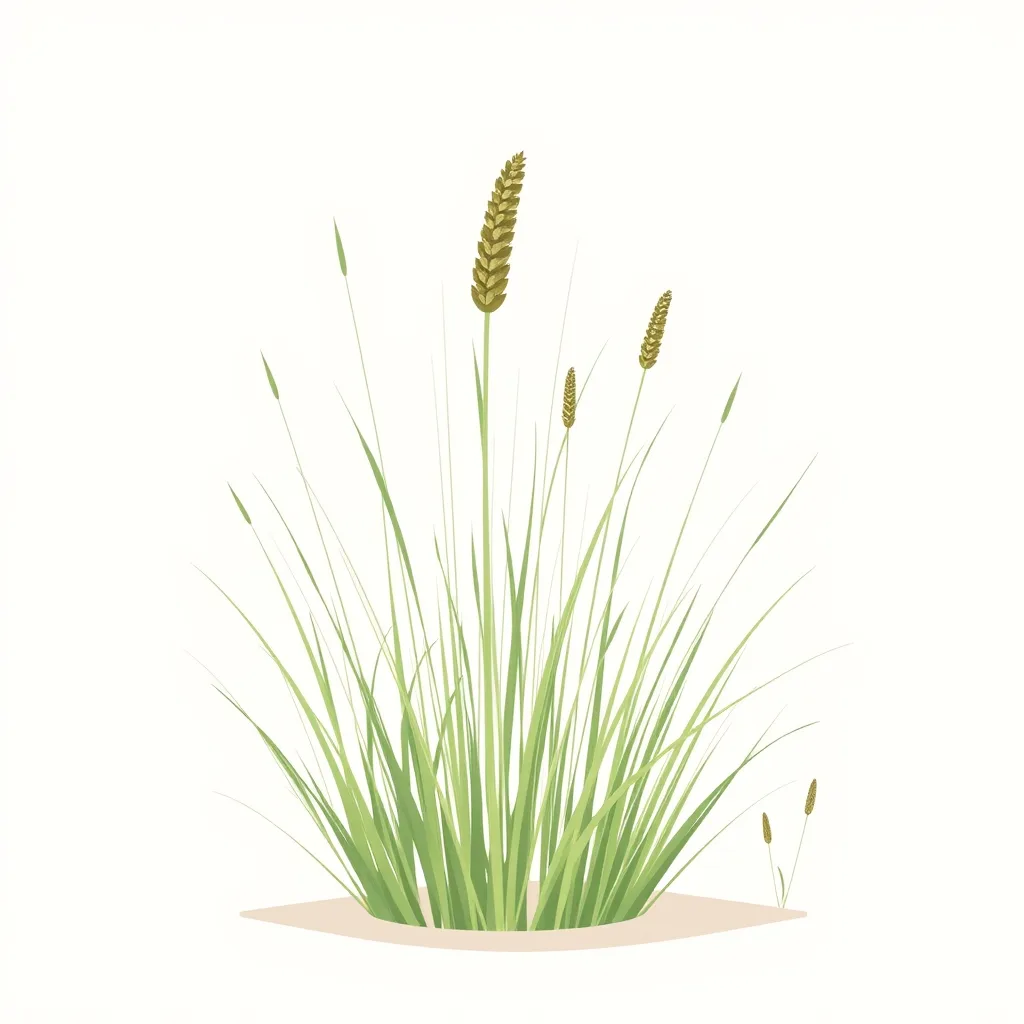
Tall fescue germination time runs 5 to 21 days across the extension sources checked for this article, not one settled figure. NC State TurfFiles names the conditions it germinates best under in a single sentence, air temperatures of 68 to 77°F and “soil temperatures greater than 60°F,” and states those as optimums rather than as a cutoff. Two of the three Tier-1 day ranges come from that same extension program, using an identical sentence frame with different numbers, a real conflict worked through below. This article belongs to the plant growth stages cluster, where fescue’s disagreement is best read beside the other cool-season timelines.
Tall Fescue Seeding and Germination by Month, August Through October
Ohio State Ohioline’s STR-1 fact sheet names mid-August to mid-September as “the best time to seed in the northern United States,” a window set for cool-season grasses broadly, not tall fescue alone. Seed going in near the front of that window has more runway before cold weather closes in.
October is where the calendar tightens, and the tightening is regional, not national. NC State TurfFiles gives an outside date for tall fescue: “try to get your seed out by mid-October, as by then the likelihood of slow/low germination will get much higher.” That sentence names no state, but TurfFiles is North Carolina State’s turf extension service, so this article reads the date as North Carolina guidance rather than a national one. Soil cools on a different calendar at different elevations and latitudes, so Colorado seeders should check Colorado’s own elevation-based grass seed dates instead of borrowing North Carolina’s date.
Fall beats spring for a separate reason: NC State TurfFiles says “spring seeding is not likely to result in a year-long stand of healthy tall fescue.”
Count 7 to 14 Days Before You Expect Fescue to Sprout
Fourteen days is a reasonable number to count against, but only a partial guarantee. Ohio State’s “five to seven days” and NC State’s faster “5 to 10 days” (its Time to Seed page) both fall comfortably inside a 14-day count. NC State’s slower figure, “10 to 21 days” from Time for Fall Seeding of Tall Fescue, does not; its own range runs a week past that checkpoint.
So a 14-day countdown is a reasonable early check, not a deadline. Bare soil at day 14 is unremarkable under NC State’s slower range and genuinely informative under either faster figure.
How Long Does Tall Fescue Take to Germinate Compared to Bluegrass or Rye
Among the three grasses most commonly seeded into a cool-season lawn, perennial ryegrass is fastest, tall fescue sits in the middle but disagrees with itself on how far into that middle, and Kentucky bluegrass is slowest. Ohio State Ohioline’s STR-1 fact sheet gives ryegrass three to five days and Kentucky bluegrass “seven to 21 days, depending on conditions.” Tall fescue spans both neighbors: five to seven days on Ohio State’s page, which counts germination and establishment together, or 5 to 10 and 10 to 21 days on the two NC State pages, which count germination alone.
Perennial ryegrass’s three-to-five-day window is fastest by a wide margin under any of fescue’s published figures. Kentucky bluegrass’s own seven-to-21-day range is the slower comparison, and how it stacks up against fescue’s own contested range gets a full section further down, since the answer changes with which NC State figure applies.
What Happens If You Expect Fescue to Sprout as Fast as Ryegrass
Ryegrass sets the expectation in most mixed seedings because it arrives first, at three to five days per Ohio State Ohioline’s STR-1 fact sheet. Fescue cannot meet that schedule under any of its three published figures. Even Ohio State’s fastest, five to seven days, begins roughly where ryegrass’s range ends.
The mismatch bites harder for fescue than it would for a slower grass carrying one settled number, because fescue carries three. Bare soil on day four is on schedule under every published figure. By day eight the same seedbed is already late under Ohio State’s range, on time under NC State’s Time to Seed, and not yet due under Time for Fall Seeding of Tall Fescue. A verdict reached by watching the fastest thing in the bag is a verdict none of the three sourced figures actually supports.
Ideal Soil Temperature Range for Tall Fescue Germination
Only one genuinely soil-based figure exists for tall fescue germination in the sources checked here, and it is worth separating from the air-temperature figures published alongside it. NC State TurfFiles gives it inside a single optimum-conditions sentence: “Optimum air temperatures for tall fescue germination are 68 to 77°F, and soil temperatures greater than 60°F.” The soil half of that sentence is the one direct soil reading in this set, and NC State states it as part of an optimum, not as a cutoff below which seed will not germinate. This article does not treat it as one.
The other published figures describe air temperature, not soil. Purdue Turfgrass Science’s Turf 101 fact sheet gives 68 to 86°F under an alternating warm and cool testing regime, noting plainly that “the temperatures listed are air temperatures which would be almost identical to that in on the surface of the soil barring radiation effects.” Ohio State Ohioline’s STR-1 fact sheet adds a wider, non-species-specific figure: “optimum air temperatures for germination of cool-season grasses is between 59 to 86 degrees Fahrenheit.” “Almost identical” is an approximation, not equivalence, so a soil-temperature question should weight NC State’s direct reading over any of these air figures.
Fescue Temperature Thresholds
| Figure | Value | Air or soil | Source |
|---|---|---|---|
| Optimum air temperature, tall fescue | 68 to 77°F | Air | NC State TurfFiles |
| Optimum germination temperature (alternating 16h/8h) | 68 to 86°F | Air | Purdue Turfgrass Science, Turf 101 |
| Cool-season grasses as a group | 59 to 86°F | Air | Ohio State Ohioline STR-1 |
| Optimum soil temperature, tall fescue | Greater than 60°F | Soil | NC State TurfFiles |
A reader with a soil probe checking for “68 to 77” or “68 to 86” is chasing an air reading under a different name.
Sow, Overseed, or Reseed Fescue: Sorting Out the Verbs
These three words point at different jobs, not interchangeable synonyms. Sowing places seed into prepared, bare soil, new lawn or stripped patch alike. Reseeding restores an existing tall fescue lawn that has thinned; NC State TurfFiles’ own term for doing this at scale is “renovation,” used in the same sentence that sets the fall window: “fall is the best time for renovation and seeding of cool-season lawns.” Overseeding, elsewhere on this site, describes introducing a faster-germinating species into an existing living lawn, a practice documented for ryegrass over dormant warm-season turf rather than for tall fescue, so the term fits fescue more loosely.
For a tall fescue lawn the distinction that matters is bare soil versus a thinned stand, since NC State’s renovation guidance and fall window cover both. What changes is the ground, not the germination figures.
How Many Weeks of Fall Growth Does Tall Fescue Need Before Winter
NC State Extension’s Rowan County office states the requirement as a count-back rather than a window: “To establish a great stand of Fescue grass, you need to ensure you seed at least six weeks before a killing frost.” Ohio State Ohioline’s STR-1 fact sheet frames the same season as a calendar instead, mid-August to mid-September for the northern United States. Two different anchors, a frost count-back and a fixed window, and neither source states one in terms of the other.
Only NC State’s figures can be set against that six weeks, because they measure germination alone and so can be subtracted from it. Ohio State’s five to seven days cannot, since it covers germination and establishment together and would double-count the second half. At NC State’s 5 to 10 days, about one of the six weeks goes to germination and the seedling has the rest to establish. At 10 to 21 days, as much as three of the six are gone before anything breaks the surface, halving the establishment time the rule asks for. That subtraction is this article’s own arithmetic rather than a published finding, and it is the clearest reason the argument over fescue’s germination range is worth having.
Tall Fescue vs Kentucky Bluegrass: Germination Speed Compared
Kentucky bluegrass publishes one range, seven to 21 days per Ohio State Ohioline’s STR-1 fact sheet. Tall fescue publishes three. The comparison therefore has no single answer available from the published figures, and that absence is the finding rather than a gap in it.
A reader blending the two species cannot settle the question by preferring the more authoritative page, because the two competing fescue figures were published by the same program. What is left is to hold all three fescue figures open and judge a seedbed against the widest of them, 21 days, before drawing a conclusion about either species. The straight side-by-side ranking, with Ohio State’s establishment-speed ratings alongside the day counts, is worked out on the bluegrass timeline rather than repeated here.
Does Tall Fescue Really Need Exactly 14 Days to Fully Sprout
No, and the sourced figures explain why a single number was never going to hold. Three Tier-1 extension figures exist, and they do not describe the same thing.
Fescue Germination Days
| Source | Days published | What that span covers | Temperature basis the same page gives |
|---|---|---|---|
| Ohio State Ohioline STR-1 | “five to seven days” | Germination and establishment together, not germination alone | “optimum air temperatures for germination of cool-season grasses is between 59 to 86 degrees Fahrenheit,” a blanket cool-season figure, not fescue-specific |
| NC State TurfFiles, Time to Seed | “5 to 10 days” | Germination | Ties the range to “suitable soil temperatures” without stating a number on that page |
| NC State TurfFiles, Time for Fall Seeding of Tall Fescue | “10 to 21 days” | Germination | The one page here that gives both, elsewhere on the same page: “68 to 77°F” air and “soil temperatures greater than 60°F” |
| Purdue Turfgrass Science, Turf 101 | Not published; Purdue’s page gives temperature ranges only, no day count, for any species | Not applicable | 68 to 86°F air, alternating 16h/8h regime, per Purdue’s stated protocol |
The most important line in that table is a repeated one, not a single number. NC State TurfFiles is one extension program, and its two pages use the same sentence structure, “germination will normally be in X to Y days with soil moisture and suitable soil temperatures,” while publishing different values for X and Y, a conflict inside one program, not between two institutions. Ohio State adds a third complication rather than settling it, since “five to seven days” measures germination and establishment together, a different span than either NC State figure. Stacking all three into a single 14-day promise treats three measurements as one, the myth this heading exists to correct.
Why Tall Fescue Seed Sometimes Shows No Sprouts After Two Weeks
Bare soil at the two-week mark means something different depending on which sourced figure applies. Under Ohio State’s five-to-seven-day figure or NC State’s faster five-to-10-day figure, 14 days with nothing visible is a real signal. Under NC State’s slower 10-to-21-day figure, 14 days is still inside the published range, and concern is premature.
Where a seeding genuinely runs past all three figures, NC State names the conditions that matter in one sentence: “If tall fescue is seeded in under less than ideal conditions (too cool or no soil moisture), you may experience a thin turf stand going into the winter.” Both are checkable. Soil below the greater-than-60°F optimum is likeliest for seed sown near the back of the window, or after NC State’s mid-October cutoff; moisture is the other half, and NC State ties each of its day ranges to “soil moisture” explicitly. A third possibility is not a growing condition at all, but mistaking fescue’s slower figure for a faster species’ clock. No source checked for this article publishes a hard failure deadline, so the honest boundary is NC State’s own ceiling of 21 days rather than a round-number guess.
There is no days-to-sprout-by-soil-temperature table on this page because none of the sources checked publishes one for tall fescue, and building it from the temperature figures they do publish would mean inventing the day counts. Every figure above names the page it came from, and those pages are listed below.
Frequently Asked Questions
Does tall fescue germinate better in spring or fall? Fall, on both counts. K-State Research and Extension states the speed side plainly: “Seed germinates more slowly in the spring when the soil is cold.” NC State TurfFiles adds the establishment side, calling fall the best time for renovation and seeding of cool-season lawns and warning that spring-established tall fescue is more susceptible to drought, heat, fungal diseases, and weed encroachment, and is not likely to result in a year-long stand of healthy tall fescue.
Can I mix tall fescue with Kentucky bluegrass seed? Yes, and it is standard practice rather than improvisation: NC State Extension publishes a combined home-lawn calendar covering tall fescue, fine fescue and Kentucky bluegrass together. Seeding rates sit outside this site’s scope, which is timing. The timing point is the germination gap, and it is not fixed: at NC State’s faster fescue figure the two species sprout on very different schedules, while at its slower figure they land in nearly the same window.
Why does tall fescue need more water to germinate than ryegrass? No source checked for this article says tall fescue needs more water than ryegrass to germinate. The sourced day counts simply show fescue taking longer to sprout, 5 to 21 days against ryegrass’s 3 to 5, so a seedbed stays moist over more calendar days, not necessarily at a higher rate.
Is turf-type tall fescue different from forage fescue for lawns? Turf-type tall fescue names cultivars bred for finer leaf texture and mowing tolerance, as distinct from older, coarser forage cultivars. The day counts in this article are published for tall fescue generally, not for named cultivars.
Does mulch help tall fescue seed germinate faster? Indirectly, by protecting moisture rather than by speeding the seed itself. University of Georgia Extension’s tall fescue seeding guidance says to apply “a straw mulch to retain moisture for improved germination and prevent erosion.” That works on the same lever NC State names, since NC State ties each of its day ranges to soil moisture. Mulch supports the condition; it does not shorten the published range.
Sources
- Ohio State University Extension, Ohioline STR-1: Cool-Season Turfgrasses
- NC State TurfFiles, Time for Fall Seeding of Tall Fescue
- NC State TurfFiles, Time to Seed
- Purdue Turfgrass Science, Turf 101: Optimum Temperatures for Seed Germination
- NC State Cooperative Extension, Rowan County Center, Fall Lawn Prep Starts Now (14 August 2023)
- NC State Extension, Tall Fescue, Hard (Fine) Fescue and Kentucky Bluegrass Home Lawn Calendar
- K-State Research and Extension, Ford County, Tall Fescue (updated 30 June 2026)
- University of Georgia CAES Field Report, tall fescue seeding guidance (31 August 2017)
Last verified: 2026-08-16, against Ohio State Ohioline STR-1, both NC State TurfFiles pages, Purdue Turfgrass Science’s Turf 101, NC State Extension’s Rowan County and home-lawn-calendar pages, K-State Research and Extension (Ford County) and the University of Georgia CAES Field Report.