
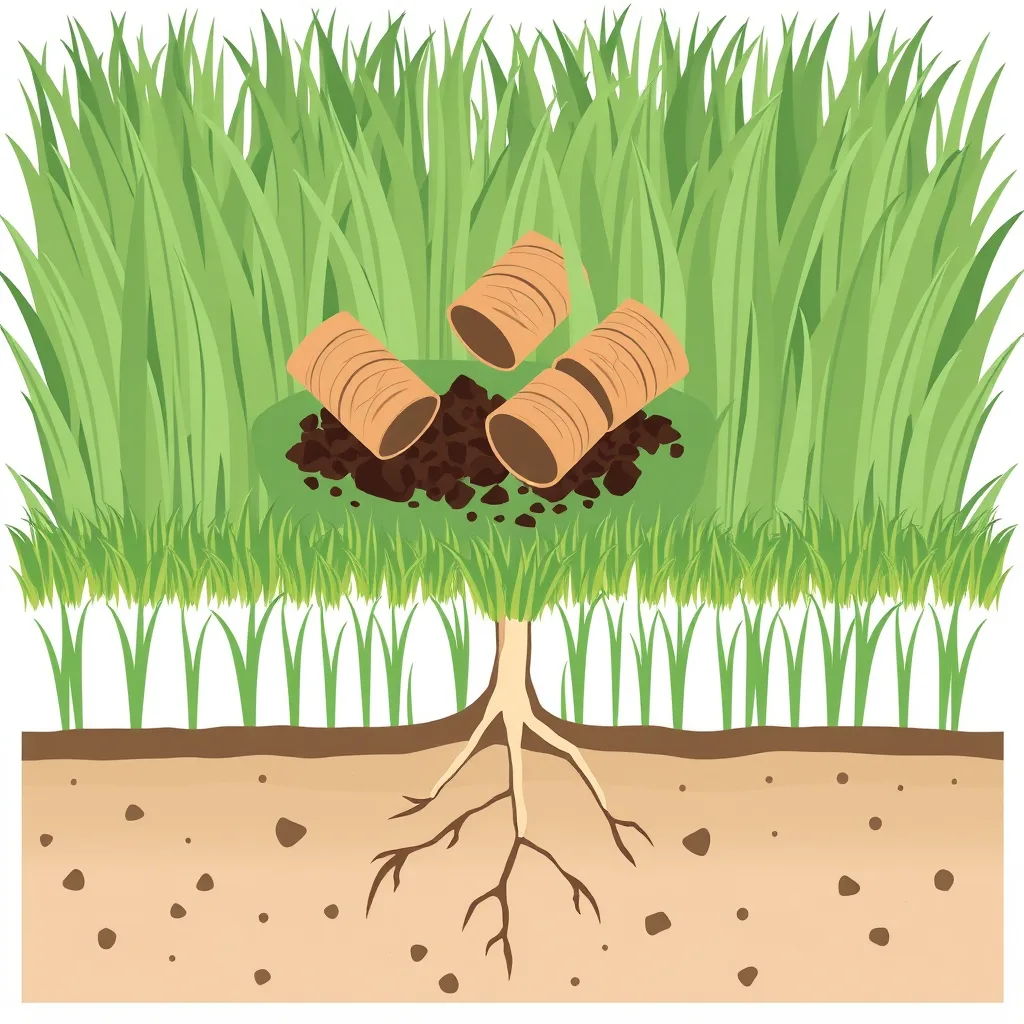
Cool-season lawns, Kentucky bluegrass and tall fescue, are ready to aerate in September and October, once summer heat eases and the grass returns to vigorous growth. Warm-season lawns, bermuda and zoysia, run on a different calendar: late spring through summer, after frost threat passes and green-up completes. Clemson HGIC’s Aerating Lawns fact sheet ties both windows to one gate, active growth, not a fixed date on either calendar. This spoke works through that gate checkpoint by checkpoint; the home yard timing calendar covers where aeration fits among the season’s other lawn and yard tasks.
Lawn Aeration Timing by Month, Late Summer Through Fall
Cool-season lawns aerate best in September and October, the months Clemson HGIC names for “less heat stress and danger of invasion by weedy annuals” once summer’s worst heat passes. Purdue Turfgrass Science broadens that, noting cool-season aeration is “generally best conducted during the spring and fall months,” making early autumn the strongest target, not the only one. Warm-season lawns skip this frame; their window sits in late spring and summer instead, covered in the calendar below. What matters is the growth state behind the month, not the calendar date itself.
Count Back Six Weeks From Your First Fall Frost to Aerate
Counting back from your average first fall frost gives cool-season aeration a real target date instead of a vague “sometime in fall.” Clemson HGIC’s sourced floor is “at least four weeks of good growing weather” after aeration for the plants to recover. In Columbus, Ohio, where NOAA/NCEI 1991-2020 Climate Normals put the average first fall frost at October 27, that floor lands around September 29 (a fuller Ohio-specific breakdown is planned for this cluster). In Denver, Colorado, where the average first frost is October 9, the same floor lands around September 11, near the early edge of the window given the shorter growing season at elevation (see the Colorado spoke). Extra cushion beyond Clemson’s floor is this site’s own conservative suggestion, not an extension figure: roughly two more weeks moves the Columbus target to mid-September and Denver to late August. Pull your own state’s average first frost date from NOAA/NWS normals before setting a date.
How Long After Aerating Should You Wait to Overseed
There is no single number that answers this correctly, because two Tier-1 extension programs give opposite sequencing advice; neither sentence states a grass-type restriction. Clemson HGIC’s general Aerating Lawns fact sheet says “allow the holes about a month to heal before seeding,” and its own stated reason is cosmetic, not agronomic: seed near the holes “will germinate and grow much better than those between the holes, giving the lawn an uneven, speckled appearance.” NC State TurfFiles takes the opposite sequence: “before seeding core aerification is recommended to reduce compacted areas,” with no waiting period stated. University of Maryland Extension agrees, saying the coring “reduces soil compaction and provides more opportunities for germinating grass seed to establish a root system,” again with no wait specified. The calendar breaks the tie in northern states: NC State’s outside date for fall seeding is mid-October, so a September aeration plus Clemson’s month-long wait can land at or past that cutoff. The honest answer is that the two programs disagree on sequence itself, Clemson for appearance and NC State, backed by Maryland, for compaction and establishment, and a reader working against a fall frost calendar should weigh that mid-October cutoff before choosing a full month’s wait. Competitor pages that publish one universal day count collapse a real disagreement between extension programs into one number.
What Happens If You Aerate a Lawn That Is Still Dormant
Aerating dormant turf wastes the pass, because nothing is growing to use the open channels. Purdue Turfgrass Science and Clemson HGIC both gate aeration on the turf being “healthy enough to recover and grow back,” not on the calendar alone. A cool-season lawn aerated too late, once growth slows into winter dormancy, will not get Clemson’s stated “four weeks of good growing weather” to recover, so the holes sit open through winter instead of filling with roots. A warm-season lawn aerated too early, before green-up and while frost risk remains, hits the same problem in reverse: no active growth yet to respond. Either way, the lawn looks aerated without gaining the benefit.
Cool-Season vs Warm-Season Aeration Calendar Side by Side
Grass type, not a soil-temperature number, splits the aeration calendar in two. No Tier-1 extension source, not Purdue, not Clemson, publishes a soil-temperature target for aeration, a gap competitor lawn-care pages often fill with an invented figure. Compare that to seeding, where a real threshold does exist (NC State Extension’s TurfFiles puts tall fescue germination at soil above 60°F): the two “soil temperature” claims measure different things, and conflating them is a common source of bad advice. The table below replaces the missing column with what extension programs actually publish, the active-growth signal for each grass type.
| Grass type | Active season | Ideal aeration window | Active-growth signal | Source |
|---|---|---|---|---|
| Kentucky bluegrass | Cool-season | Fall (September-October) | Vigorous regrowth once summer heat stress eases, not dormant turf | Clemson HGIC, Aerating Lawns; Purdue Turfgrass Science |
| Tall fescue | Cool-season | Fall (September-October); spring is also workable | Same fall-regrowth signal as bluegrass | Clemson HGIC, Aerating Lawns; Purdue Turfgrass Science |
| Bermudagrass | Warm-season | Late spring through summer, after frost threat passes | Green-up complete, lawn back on a weekly mowing schedule | Clemson HGIC, Aerating Lawns; Clemson HGIC, Bermudagrass Maintenance Calendar |
| Zoysiagrass | Warm-season | Late spring through summer, after frost threat and green-up | Green-up complete for your own region, which shifts from coastal to mountain areas | Clemson HGIC, Aerating Lawns; Clemson HGIC, Zoysiagrass Maintenance Calendar |
Zoysia’s green-up date alone moves by weeks across South Carolina, from April along the coast to mid-May in higher mountain areas per Clemson’s maintenance calendar, which is exactly why the signal in this table is “green-up complete” rather than a fixed date.
What ‘Core Aeration’ Actually Means Compared to Spike Aeration
Core aeration removes small plugs of soil and thatch, depositing them on the surface and opening real channels into the root zone. Spike aeration, sometimes called slicing, pushes solid tines into the soil without removing material, so no plug comes out and no true channel opens. Clemson HGIC finds “core aerification will be most effective” among the practices it compares, which is why this article treats core aeration, not spike aeration, as the reference practice.
How Compacted Does Soil Need to Be Before Aeration Helps
Compacted soil is packed dense enough that roots, water, and air struggle to move through it; lawns under heavy foot or vehicle traffic, or on clay soils, compact faster than lightly used lawns on looser ground. A simple push test with a screwdriver or similar slim probe gives home gardeners a rough, informal read on compaction.
| Push resistance | What it suggests | Next step |
|---|---|---|
| Slides in with light hand pressure | Loose, uncompacted soil | Aeration is optional for this year |
| Moderate, steady resistance to push through | Borderline compaction, especially along traffic paths | Reassess again next season; watch for thinning turf |
| Stops quickly and will not advance further | Likely compacted | Schedule aeration inside your grass type’s active-growth window from the table above |
This is a qualitative gut check, not a measured test with a published standard, so treat the result as a starting point, not a diagnosis. A lawn showing thinning, water pooling after rain, or a hard, packed underfoot feel alongside firm resistance here is a reasonable aeration candidate once its window arrives.
Aerating in Spring vs Fall: Which Timing Actually Works Better
For cool-season lawns, fall is the stronger default, and Clemson HGIC’s reasoning is specific: less heat stress on the turf and less opportunity for weedy annuals to move into open soil. Purdue Turfgrass Science does not rule out spring, listing “spring and fall” together as generally workable, and adds a real spring advantage: soil tends to be more moist, which “enables the aerification equipment to remove a deeper plug.” The honest comparison is not fall-always-wins: fall carries less weed and heat risk, while spring pulls a more complete plug from wetter soil. Either can work, depending on which tradeoff matters more. Warm-season lawns sit outside this comparison entirely; their window stays fixed to late spring through summer, tied to frost passing and green-up completing.
Does a Lawn Really Need Aeration Every Single Year
No, annual aeration is not a universal requirement. Clemson HGIC gives a real range, “from once every couple of years, to 2 to 4 times during the growing season,” tied to how much traffic the lawn sees and what soil it grows in. A lightly used lawn on looser soil can go two years between passes; a high-traffic lawn on heavy clay may need aeration more than once a season. Treat “aerate every fall” as a habit worth checking against your own lawn, not a fixed rule.
Why Some Lawns Show No Improvement After Aeration
A lawn that looks unchanged weeks after aeration usually traces to one of a few checkable causes, not the practice failing. Aerating dormant turf is the most common cause; without active growth, nothing uses the open channels. Wet soil is another; Purdue Turfgrass Science warns that on excessively wet sites “the tines on the machine may simply become plugged with soil,” blunting the whole pass. A third is skipping Clemson HGIC’s recovery window, “at least four weeks of good growing weather,” and judging results before the turf has had time to respond. A fourth is aerating a thinning lawn without following through with overseeding, since the holes alone do not thicken turf; new seed reaching soil through them does.
If You Missed the Fall Aeration Window, Here Is What Still Works
Missing fall is not the end of the season for cool-season lawns; Purdue Turfgrass Science lists spring alongside fall as generally workable, so a lawn missing September and October can still aerate the following spring once growth resumes. Warm-season lawns get no such backup; their window is tied to green-up and the end of frost risk, so a bermuda or zoysia lawn that misses late spring through summer should wait for next year’s green-up rather than aerate dormant turf, which gives no real benefit. If overseeding was the real goal, a dedicated look at that timing question is planned elsewhere in this cluster.
Aeration Timing by Region: Northeast, Transition Zone, and South
Regional timing still comes back to the same grass-type gate; geography mainly shifts when active growth starts and ends. In the Northeast, lawns are almost entirely cool-season (bluegrass, fescue, ryegrass), so the fall window above applies as written, and the same logic covers other cool-season states, including Ohio, further west. In the transition zone, the broad middle band where both grass types are commonly grown, the window depends on which grass is in the yard, not the region: a fescue lawn follows the fall cool-season window, while a zoysia or bermuda lawn in the same town follows the warm-season window instead. In the South, warm-season grasses dominate, so timing tracks green-up and the end of frost risk rather than a fall date, matching the bermuda and zoysia rows in the calendar table above.
Aerate, Dethatch, or Core Cultivate: Sorting Out the Verbs
These three terms are not interchangeable, though used loosely. Aerating removes plugs of soil to relieve compaction, as described above. Dethatching is separate: it removes thatch, the layer of dead and living plant tissue that builds up between the soil surface and grass blades, distinct from compaction below the soil line. “Core cultivation” is not a third task; it is the more technical name extension programs use for core aeration. Fall’s active-growth window is also the shared season for other cool-season lawn tasks, including fertilizing timing covered elsewhere in this cluster.
When Should You Aerate a New Lawn for the First Time
A new lawn, whether started from seed or laid as sod, needs a full season of active growth before its first aeration, not a fixed week count after planting. The reasoning follows the same active-growth, root-strength gate covering every aeration decision here: a young lawn’s roots are not developed enough to handle core removal or recover the way an established lawn can. Practically, a lawn seeded or sodded this year should wait for its first full cool-season fall window, or first full warm-season late-spring-to-summer window, the year after establishment, rather than being aerated in its first season.
Frequently Asked Questions
Can you aerate a lawn that was just seeded this spring? No. Wait a full season of active growth before aerating; a young root system cannot yet handle core removal.
Does aeration help with weeds directly? Not directly. Aeration is a physical practice, not a weed treatment, though the fall window carries less risk from weedy annuals.
How soon can you mow after aerating? No fixed day count exists. Resume normal mowing once soil plugs break down and no longer drag under the mower.
Is liquid aeration the same as core aeration? No. Core aeration removes plugs of soil and thatch, opening real channels; liquid products only coat the surface. This article covers core aeration only.
Does aerating help lawns that stay wet after rain? It can improve infiltration over time, but Purdue warns saturated soil clogs the tines; Clemson recommends moderately moist soil, not wet.
What soil temperature is too cold for aeration to help? None published. The gate is active growth, not a thermometer reading; see the active-growth signal column in the table above.
Sources
- Clemson HGIC, Aerating Lawns
- Clemson HGIC, Bermudagrass Maintenance Calendar
- Clemson HGIC, Zoysiagrass Maintenance Calendar
- Purdue Turfgrass Science, Spring Lawn Aerification
- NC State TurfFiles, Time for Fall Seeding of Tall Fescue for the fall seeding outside date and fescue germination threshold
- NC State TurfFiles, Time to Seed for aerification before seeding
- University of Maryland Extension, Improving a Struggling Lawn and Repairing Damage
- NOAA/NCEI 1991-2020 Climate Normals for Columbus, Ohio and Denver, Colorado average first fall frost dates
Last verified: 2026-08-15, against Clemson HGIC, Purdue Turfgrass Science, NC State TurfFiles, University of Maryland Extension and NOAA/NCEI 1991-2020 Climate Normals.